Near-peer conflict has collapsed the distance between "care" and "contact." In the transparent battlespace, movement is observed, patterns are learned, and emissions are hunted.
Medical teams now face a lethal choice at the point of injury: digitize care and risk creating detectable RF signatures, or go operationally silent and accept the loss of data continuity precisely when continuity matters most.
NATO framed this challenge inside an approximately 8 km drone-contested zone where surveillance, jamming, and precision strike threats make evacuation slow, dangerous, and frequently delayed [1]. Independent assessments describe elevated drone-strike risk extending far beyond the immediate line of contact, reaching 15 to 20 km in some sectors [2].
Evacuation delays of 60 to 120 minutes have become common in this threat geometry, turning the classic "Golden Hour" into what is often a "Golden Day" [1].
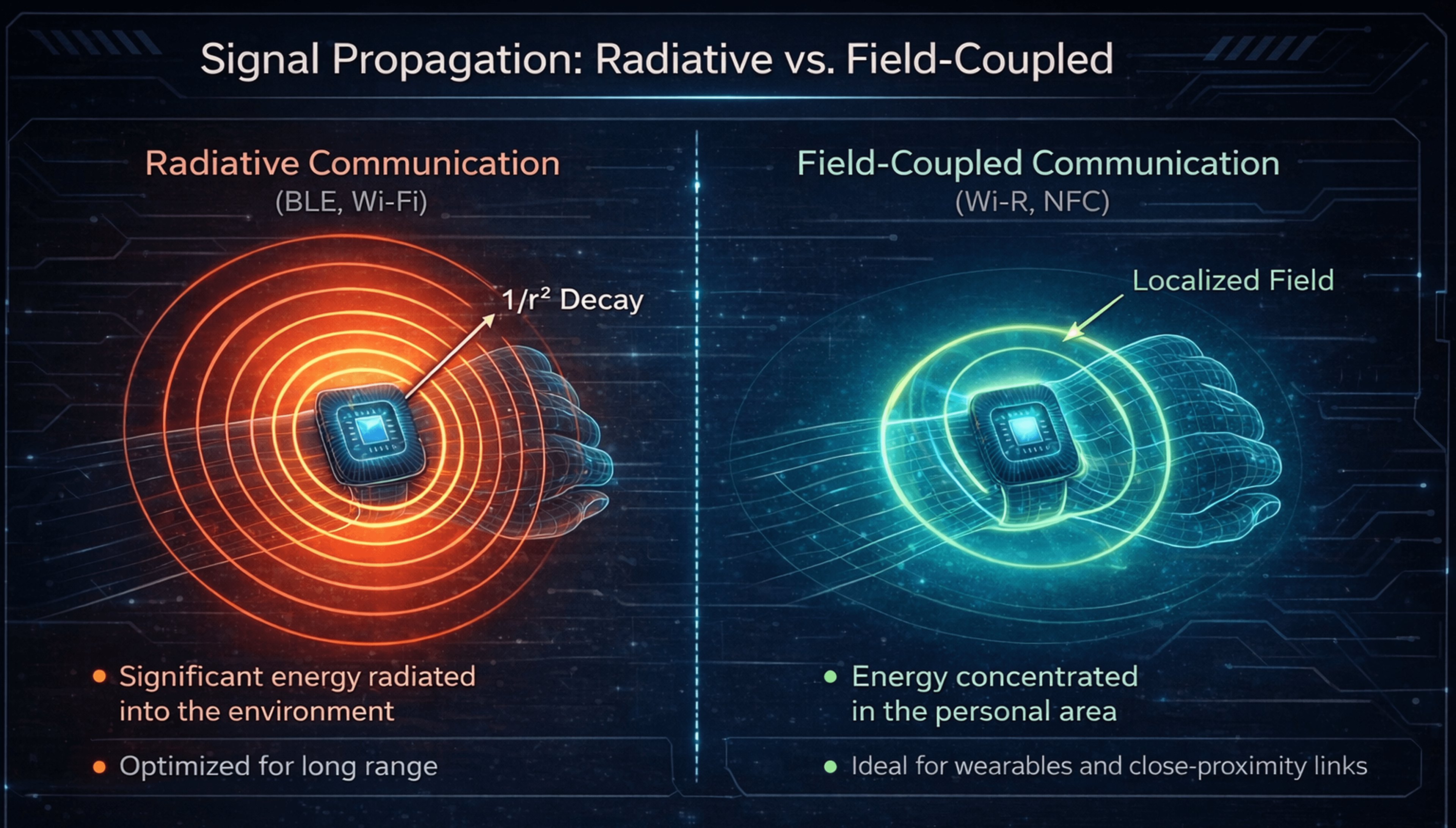
Figure 1: The Physics of Survivability. Radiative vs. Field-Coupled Signal Propagation.
Persistence: Small UAVs and FPV systems compress decision cycles. Movement that used to be "routine" becomes observable, patternable, and targetable.
Depth: The contested zone expands, pushing risk into areas that used to be treated as rear.
Fragility: Connectivity assumptions fail. RUSI field notes describe casualty evacuation becoming extremely difficult under FPV coverage and precision fires, with wounded often stabilized in place and moved only when conditions permit [3].
Medical systems are also being attacked directly. A U.S. Army medical publication summarizing WHO reporting cites 1,986 attacks on health care infrastructure and 428 attacks on medical evacuation vehicles in Ukraine from 24 February 2022 through 23 April 2025 [4].
"In this environment, signature management for medical teams is not optional. It is survivability." [4]
When digital transport layers fail or become too risky, medics revert to what survives: a Sharpie writing vitals directly on the patient's forehead and manual paper forms.
"This is not a training failure. It is a network failure."
That failure is amplified because documentation remains required. Point-of-injury care is captured on DD Form 1380 (commonly known as the TCCC Card), and higher roles of care require that documentation to be captured into clinical systems [5][6]. The form exists because the medical narrative matters: it drives handoff quality, prevents duplicated or missed interventions, and supports trauma-system learning.
When the link collapses, continuity collapses. The casualty arrives without a reliable timeline of interventions. Vitals history is lost. Medication timing blurs. Clinical decision-making slows.
Bluetooth and Wi-Fi work in permissive environments. They break in contested combat medicine because they are built on the wrong physics and the wrong assumptions.
They radiate. Even short-range RF protocols broadcast energy into the environment. That energy can be detected, exploited, jammed, or restricted by emission control.
Range is a liability. Bluetooth 5 long-range modes are explicitly designed to extend range [7]. In the transparent battlespace, range is a liability.
Friction. They assume clean spectrum and user attention. At the point of injury, pairing friction and touch-interface limitations under gloves, contamination, water, and stress are not edge cases. They are normal.
NATO's medical communications problem statement embeds the same conclusion: medical command-and-control links near the front must be low probability of intercept, resilient under GNSS denial, and able to operate under jamming [1].
Wi-R removes the tradeoff by changing the transport layer itself. Instead of radiating RF, Wi-R uses confined near-field electric communication. The operational promise is simple: move medical data without broadcasting it.
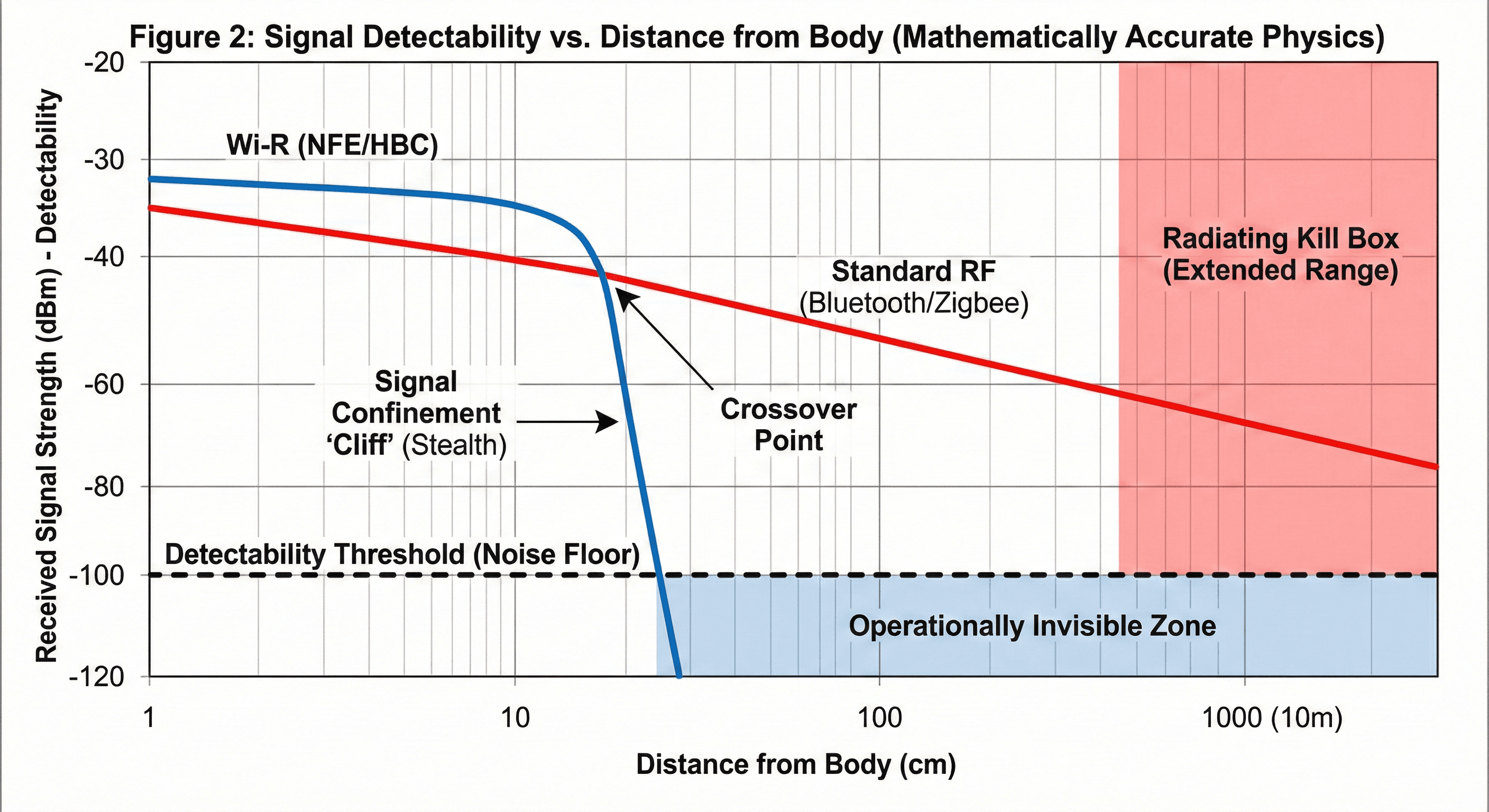
The scientific basis for confined electric-field communication is established in open literature on electro-quasistatic on-person communication, explored explicitly as a covert on-person network because signal leakage is tightly localized compared to radiative wireless [8]. Ixana's published technical framing relies on rapid near-field decay to achieve low probability of detection, with detectability concerns constrained to very short distances in air [9].
Figure 2: Signal Detectability vs. Distance from Body. The "Confinement Cliff" ensures invisibility beyond the immediate treatment zone.
"The most valuable links are often the shortest-range ones, because they keep working without making the user targetable."
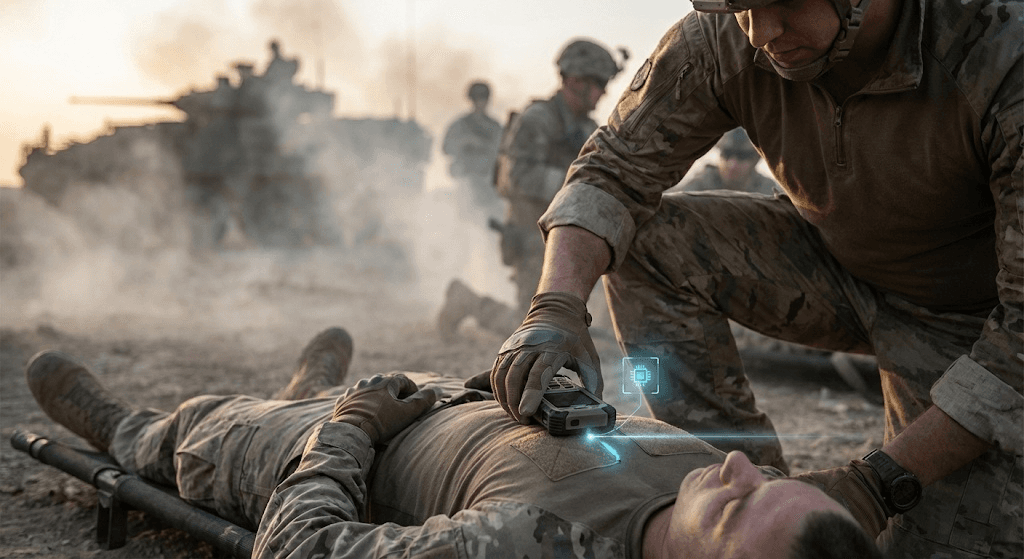
Touch-to-triage replaces pairing workflows with a physical action that already exists in care: contact. The medic touches a casualty tag, wearable, or triage device and exchanges triage data and vital signs immediately. Proximity becomes the access-control boundary.
Unlike NFC, which forces the medic to locate and tap individual sensors one by one, Wi-R integrates the operator’s entire wearable suite into a single, accessible network. A single point of contact, anywhere on the uniform or equipment-bridges the medic into the casualty's aggregate data stream, pulling vitals and history simultaneously without requiring alignment with specific devices.
Figure 3: Touch-to-Triage workflow allows instant data exchange through physical contact.
NATO's Innovation Challenge winner descriptions explicitly include touch-based transfer of triage information and vitals using confined electric fields, designed for heavily jammed environments with minimal emissions [1]. Wi-R NFE-class links target this "last decimeter" problem: secure short-range transfer with low power, sub-millisecond-class latency targets, and multi-megabit throughput [10].
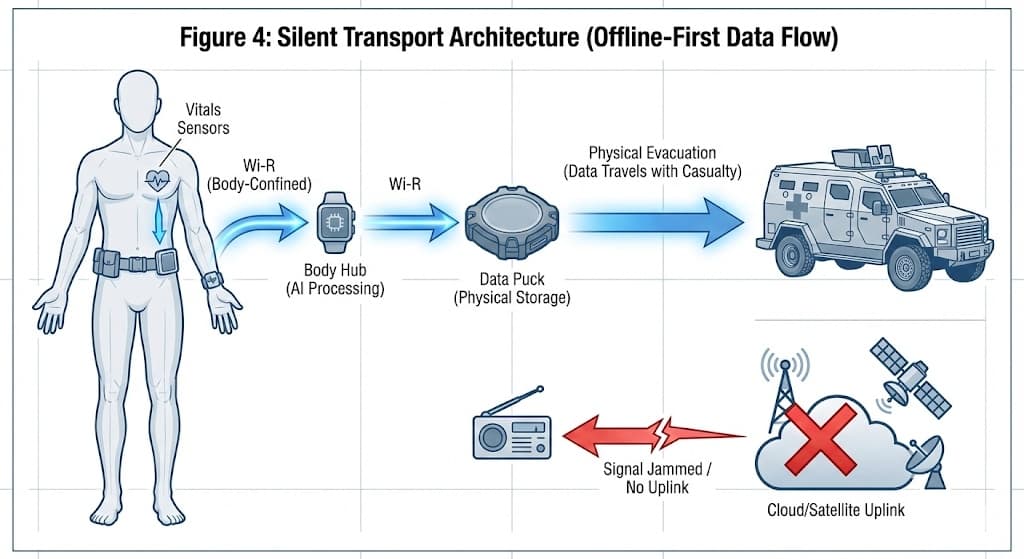
Documentation breaks because manual workflows do not scale under casualty load and because wide-area connectivity cannot be assumed. The remedy is an offline-first medical record that updates continuously and synchronizes only when safe.
Wi-R BAN-class links enable a sensor-to-hub network for vital signs and device data without radiating [11]. That local data stream can feed Edge AI for automation: auto-logging vitals, time-stamping interventions, flagging trend risk, and reducing cognitive burden during prolonged field care.
Figure 4: Autonomous Documentation Architecture. Data moves locally from body → hub → puck, enabling continuity without connectivity.
The AI layer is designed for ease of integration with modern medical data management systems like Mercury, BATDOK, and TMED.
DD Form 1380 exists because handoff data saves lives [5][6]. Wi-R ensures that the digital TCCC Card travels with the casualty during handoff to higher levels of care (Role 1-4), maintaining continuity of care without reliance on cloud connectivity.
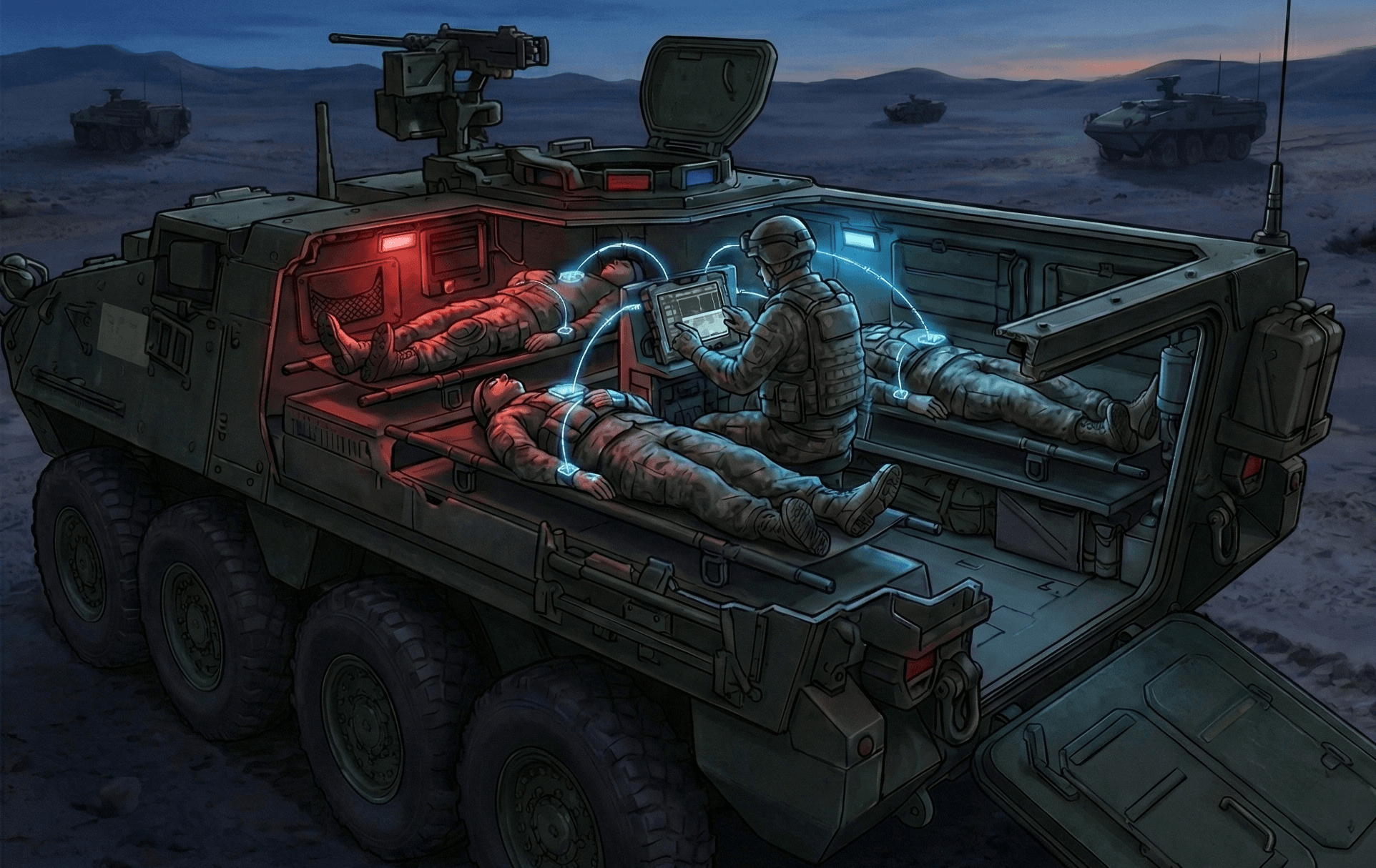
Inside evacuation vehicles, the temptation is to create a wireless "cloud" of monitors, hubs, and tablets. In a transparent battlespace, that is an emissions problem.
Wi-R enables intra-vehicle connectivity for monitoring multiple casualties while keeping emissions localized. The vehicle becomes a low-observable medical network node that synchronizes to wider tactical networks only when conditions permit. This supports the NATO requirement for protected extraction and resilient medical command-and-control in contested environments [1].
Figure 5: Connected Inside, Silent Outside. Secure multi-casualty monitoring in a contested environment.
NATO Selection
Ixana was named a third-place winner in NATO's 17th Innovation Challenge focused on low-probability-of-intercept and low-probability-of-detection medical command-and-control and touch-to-triage vital-sign transfer [1]. Submissions were evaluated for operational relevance, feasibility, readiness, cost, and speed to fielding [1].
Physics of Security
The practical security comparison is geometric. Confined electric-field links are designed to keep detectability in air below approximately 0.5 m in typical configurations, while Bluetooth is explicitly designed for tens to hundreds of meters depending on mode and environment [7][8]. Tactical radios are built for kilometers-scale links. Reducing the detectable footprint from "hundreds of meters" to "sub-meter" changes the targeting problem.
Energy Efficiency
Wi-R consumes approximately 100x less power per bit than Bluetooth Low Energy, extending battery life for body-worn sensors during prolonged operations where resupply is tactically constrained.
Commercial De-risking
Wi-R is not positioned as a bespoke prototype. Ixana is venture funded with a long runway and already has commercial traction with design-ins.
Resilience under EW: Wi-R's baseline signature is low, reducing detection range. When required, spread-spectrum techniques (DSSS) provide additional hardening [12].
Drop-in Upgrade: Wi-R is a transport upgrade for ecosystems like Nett Warrior and the Soldier Borne Mission Computer (SBMC). It moves data locally with minimal emissions, while tactical networks move data beyond the line of contact when permitted [13][14].
This aligns with the DoW JADC2 strategy emphasis on resilient infrastructure, increased data flow, and automation for faster decision cycles [15].
Schedule a hardware demonstration focused on medical command-and-control in contested environments, or request the classified TCCC Integration Technical Brief.
Elmore Associate Professor of ECE & BME at Purdue, Founder & CTO of Ixana, MIT TR35, TEDx, GT 40U40
Illustrative use case only. This page describes example workflows and interoperability concepts involving Ixana Wi‑R technology and third-party systems. Unless expressly stated otherwise, Ixana provides communications silicon, circuit boards and firmware components for E-field based body-area-network and near-field data transfer and is not offering complete medical device, clinical triage system, or finished end products.