Jan 2, 2026Shreyas Sen6 min read
Why Wi-R, Why Now: Fixing Today’s Bottlenecks, Enabling Tomorrow’s AI
Why Wi‑R, Why Now: Fixing Today’s Bottlenecks, Enabling Tomorrow’s AI
If Wi‑R had been discovered five years ago, the headline would have been simple: "The end of daily charging and audio lag."
You would have seen earbuds that hit 20 hours of battery life with wire-like latency for gaming. You would have seen smartwatches that stream continuous heart health data 24/7 without dying by noon and smartglasses that stream video the entire day. You would have seen reduced pairing friction, with user-initiated tap to establish a link.
That value proposition alone targets categories shipping at massive scale: audio, wearables, accessories, and proximity interactions that already touch billions of devices annually.
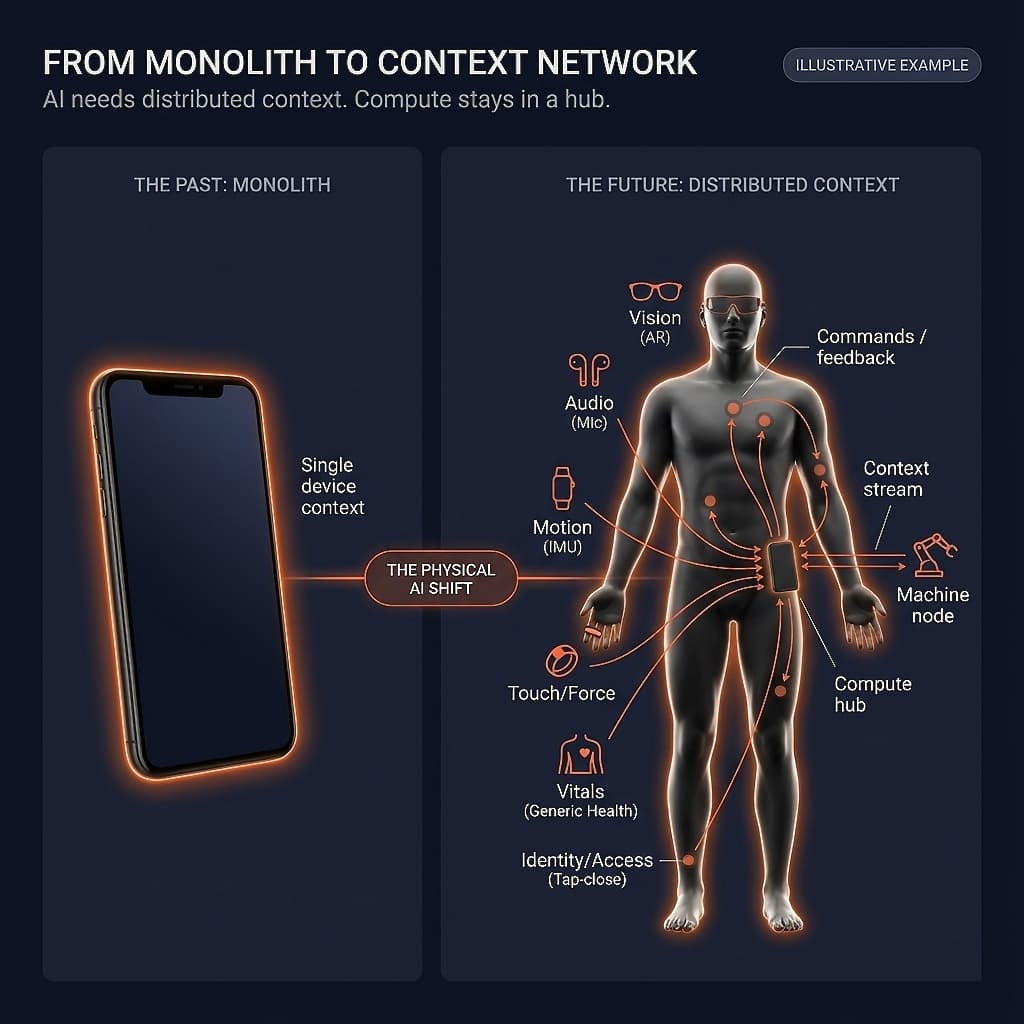
But today, the context has shifted even further. We aren't just trying to fix the frustrations of connected devices; we are building the foundation for multimodal physical AI. The industry is moving toward systems that sense continuously, fuse data in real-time, and act physically.
Wi‑R matters now because it does both: it addresses the broken user experiences of today while enabling the distributed intelligence of tomorrow.
1. Removing the Latency and Power Tax in Always-On Products
We have accepted limitations in our daily devices that we shouldn't have to. Bluetooth has been a workhorse, but for modern continuous applications, it imposes a heavy tax:
- The Latency Tax: Gamers and creators often rely on wired headphones or proprietary dongles because standard wireless lag breaks the experience.
- The Power Tax: Smartwatches "sample" your health every few minutes because streaming continuous data would drain the battery in hours. Smartglasses only take 1 min videos and images because continuous streaming video is impractical.
- The Spectrum Tax: In crowded gyms, offices, and airports, devices fight for the same 2.4 GHz spectrum, leading to dropouts and jitter.
The Power Tax
Always-on sensing drains batteries in hours, forcing devices to "sleep" and miss critical context.
The Latency Tax
Standard wireless lag breaks the real-time fusion needed for seamless AI assistance and immersive gaming.
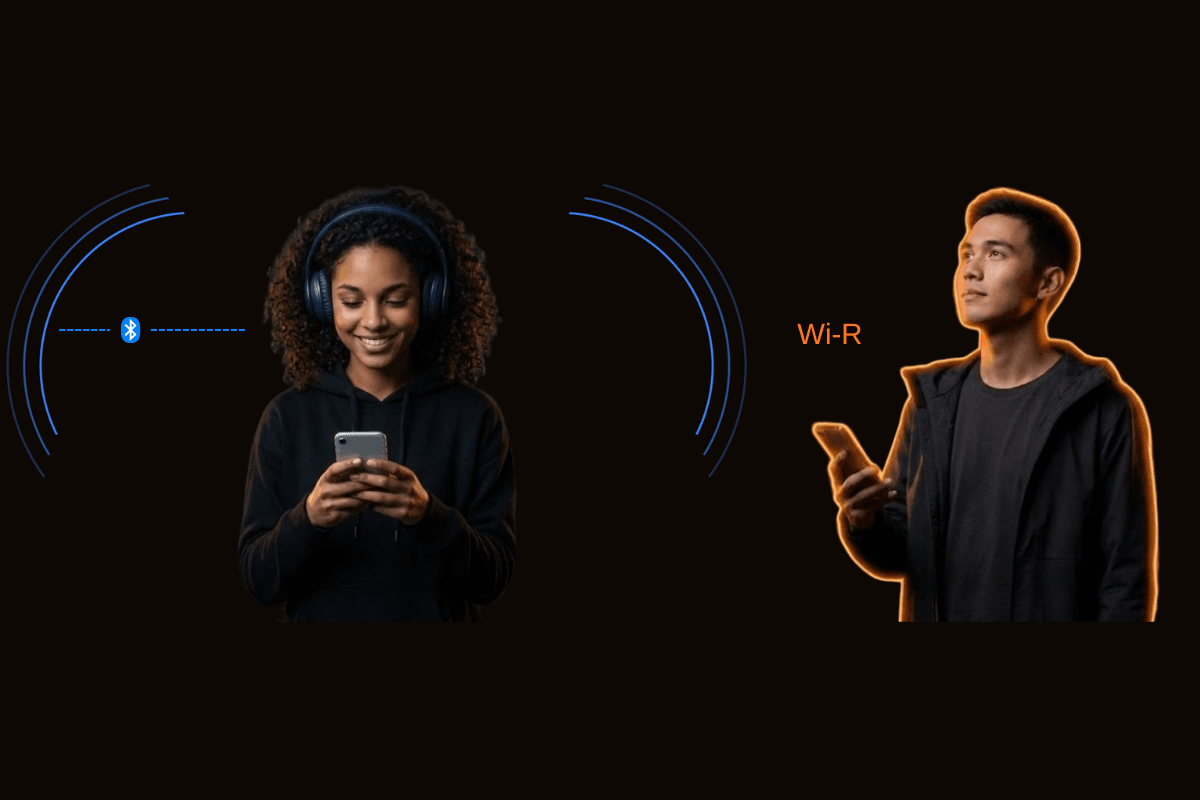
Wi‑R BAN (on-person stream) acts as a dedicated on-person link that addresses these constraints at the physical layer:
- < 1 ms Latency: For gaming and real-time monitoring, sub-millisecond class link latency enables wire-like responsiveness.
- Up to 100x Better Energy Efficiency (vs BLE): Continuous 5 Mbit/s streaming with < 1 mW communications power makes always-on sensing architectures practical.
- Robust in Crowded RF: The signal is confined to the wearer’s immediate vicinity (about 10 cm off-person), meaning it does not compete for crowded 2.4 GHz airwaves.
- Multi-Device Scalability: Like NFE, BAN supports up to 16 nodes, enabling complex on-person sensor networks that can all stream simultaneously.
This isn't just for future robots. It’s for the earbuds, watches, and AR glasses being designed right now.
2. Fixing the "Pairing & Service" Nightmare
How many times have you struggled to pair a new device? Or waited for a firmware update to crawl over a slow link?
The current standard, NFC, was built for small bursts of data (payments), not for managing complex devices. As products become portless and ruggedized, from waterproof smartphones to industrial sensors, we need a better way to get data in and out.
Wi‑R NFE (Near Field Electric) is the upgrade the industry has been waiting for:
- Touch-to-Connect: No menus. No "discovery mode." User-initiated connection on contact or close proximity.
- 5 Mbit/s Data Rate: That’s 10x faster than NFC. A 10 MB configuration bundle transfers in ~16 seconds, and even 100 MB-class service payloads move in a few minutes.
- Ruggedized Design Support: NFE supports ruggedized designs by enabling high-speed service and provisioning without exposed ports.
- Group Provisioning: With support for up to 16 nodes, a single touch can provision an entire kit of devices, ideal for medical, education, or tactical deployments.
This solves an immediate headache in consumer electronics, industrial IoT, and defense systems: making complex devices easy to use and maintain.
3. The "Why Now" for Physical AI: From Nice-to-Have to Necessary
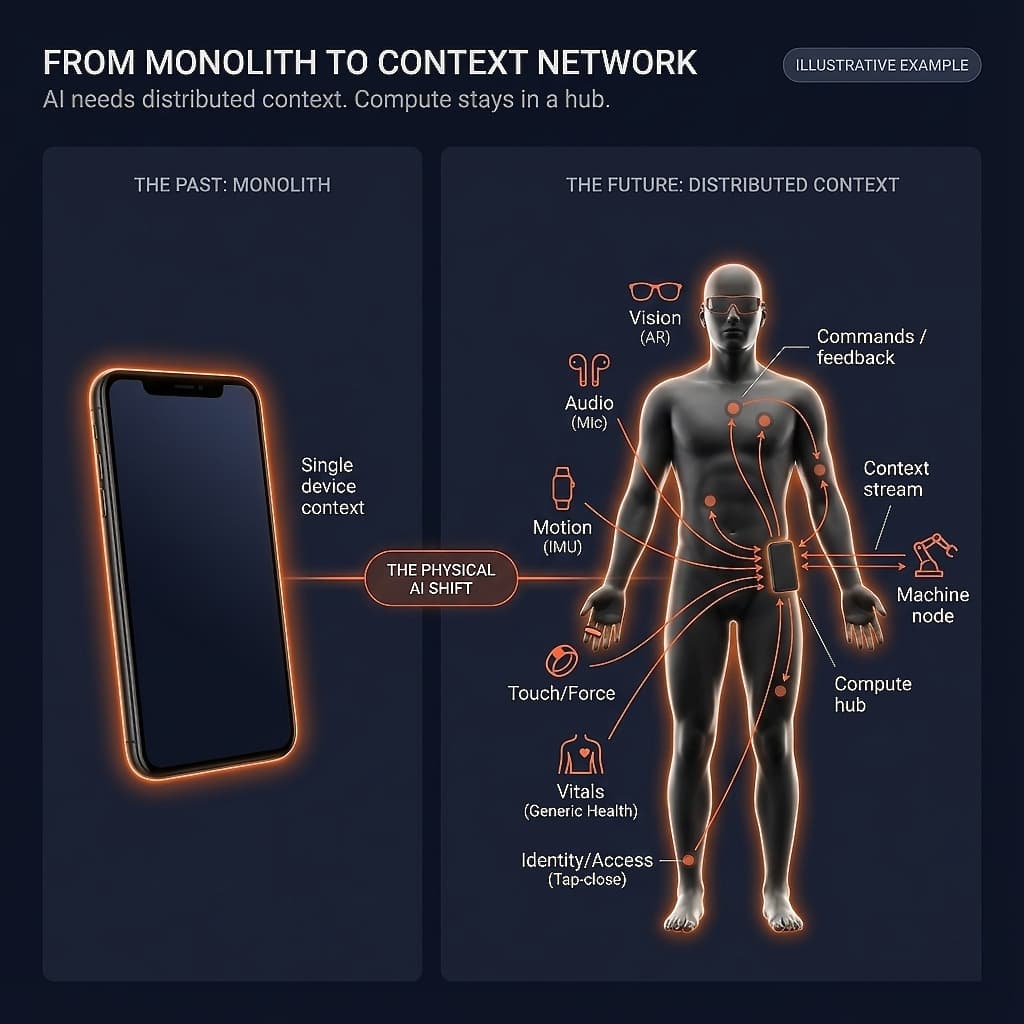
While we fix today's devices, a new wave of computing is arriving: Multimodal Physical AI.
PDF
Human-Inspired Distributed Wearable AI
DAC '24 - Sen et al.
->
These systems are different. They don't just "connect" occasionally; they live in a state of continuous, high-speed interaction. They need to see, hear, and sense the world constantly, fusing that data to understand intent and context.
- Distributed Sensing: Sensors need to be where the physics demands (on the wrist, on the glasses, on the clothes), not where the battery is biggest.
- Real-Time Fusion: To feel "smart," an AI assistant needs to see what you see and hear what you hear instantly. Tens of milliseconds of delay can degrade perceived responsiveness and fusion quality.
- Privacy by Physics: People want AI help, but they don't want to broadcast their lives to the entire room. Wi‑R’s field is localized to the wearer’s immediate vicinity (about 10 cm off-person), reducing the attack surface by design.
This is where Wi‑R transforms from a "better radio" into an architectural necessity. It provides the always-on data plane (BAN) that lets AI sense continuously without killing the battery, and the intentional proximity plane (NFE) that lets users establish trust and control through physical touch.
The New Connectivity Pattern
The most useful way to think about Wi‑R is as a single platform with two modes that match how humans and machines actually interact. Because BAN and NFE are designed as a complementary platform, teams can reuse design patterns across the always-on stream and proximity touch experiences.
Wi-R BAN
The "Always-On" Stream
- Superpower< 1 mW comms power
- Key Use CaseAll-day XR, Continuous Health
Wi-R NFE
The "Intentional" Touch
- SuperpowerHigh-speed transfer through sealed cases
- Key Use CaseInstant pairing, Firmware updates
Conclusion: The Best of Both Worlds
We don't have to choose between fixing today's frustrations and building tomorrow's advanced systems.
The "Why Now" for Wi‑R is twofold:
- Immediate Relief: We can stop accepting audio lag, daily charging, and pairing failures in the devices we build and use today.
- Future Enabling: We can finally build the distributed, physical AI systems that have been stuck in the lab because the connectivity layer wasn't ready.
Whether you are building the next generation of consumer audio or the first generation of AI copilots, the bottleneck is no longer the link. It’s what you choose to build with it.
Physical AIWi-RWearablesDistributed ComputingNear-Field

Shreyas Sen
Elmore Associate Professor of ECE & BME at Purdue, Founder & CTO of Ixana, MIT TR35, TEDx, GT 40U40
Illustrative use case only. This page describes example workflows and interoperability concepts involving Ixana Wi‑R technology and third-party systems. Unless expressly stated otherwise, Ixana provides communications silicon, circuit boards and firmware components for E-field based body-area-network and near-field data transfer and is not offering complete medical device, clinical triage system, or finished end products.