May 21, 2026Ixana Team15 min read
Wearable AI Has a Data Problem, Not Just a Model Problem
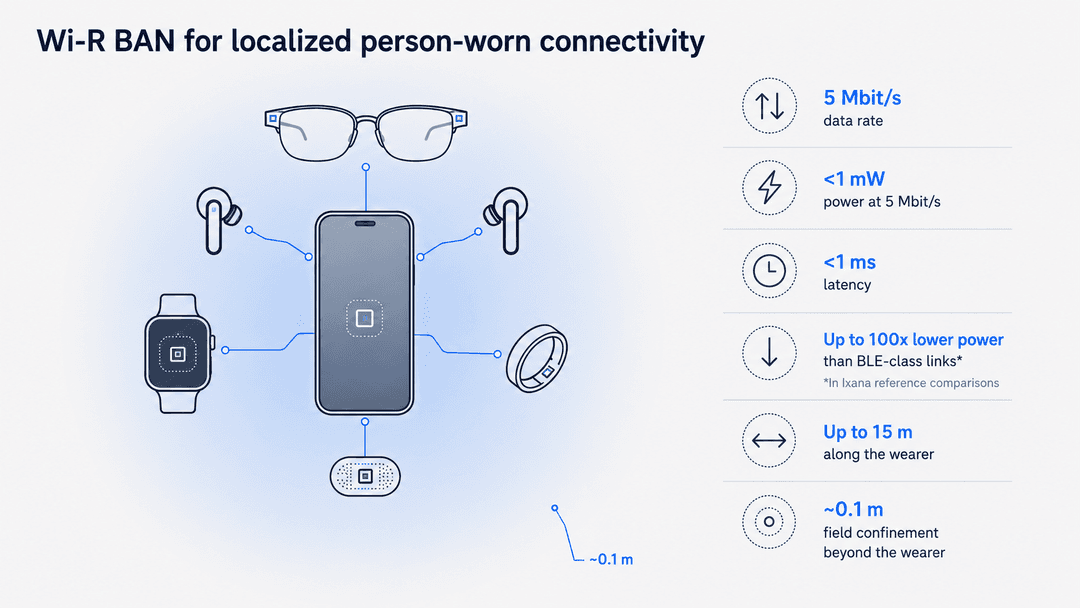
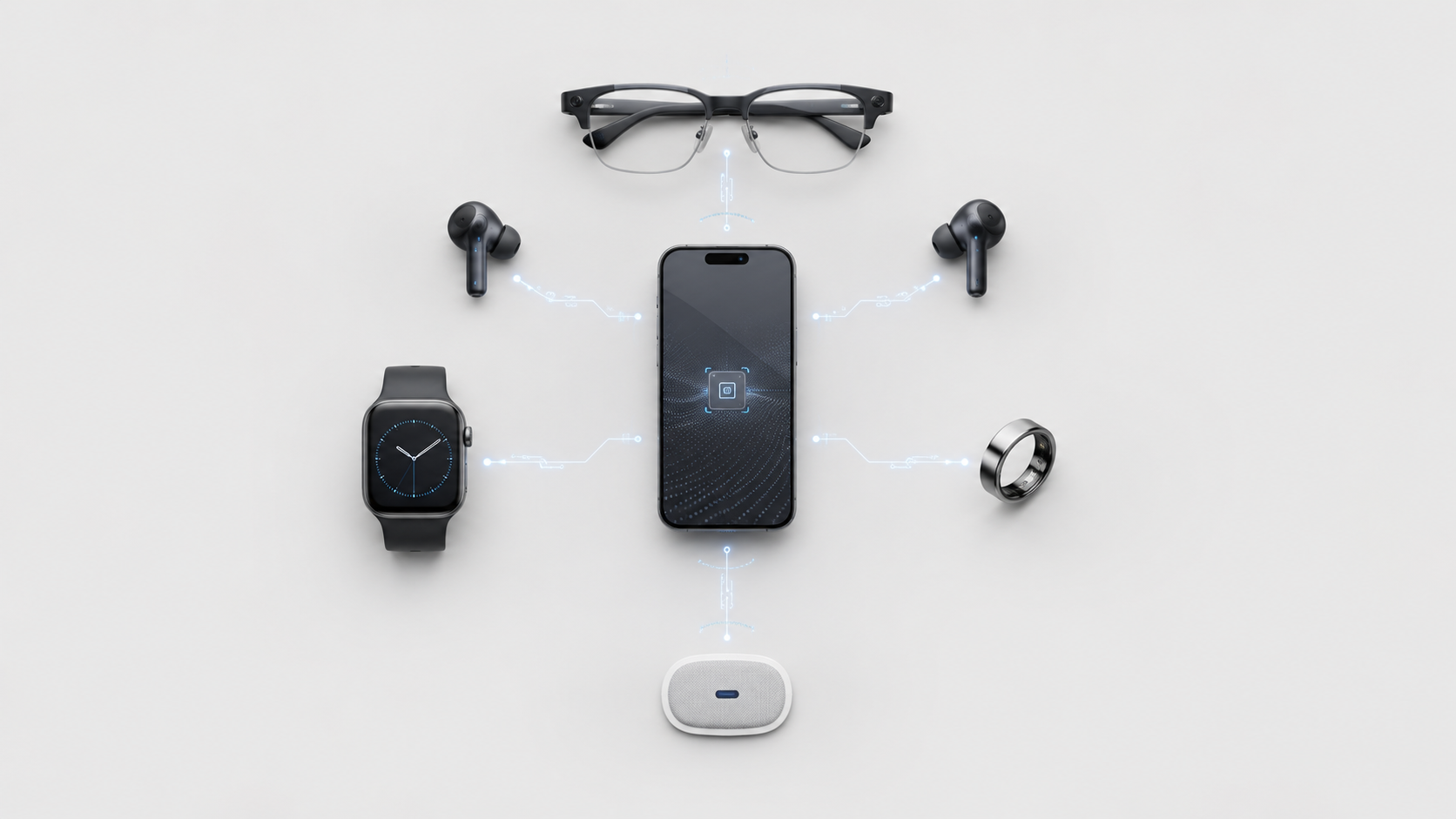
Wearable AI depends on synchronized, usable sensor data moving across person-worn devices.
Wearable AI is moving fast. Models are getting smaller. Processors are getting more capable. Sensors are spreading across watches, rings, earbuds, smart glasses, phones, patches, and mission systems.
That progress is real. It is also incomplete.
The wearable industry has spent years celebrating sensors and processors while underestimating the link between them. A smarter model still depends on the signals it receives, and in real-world wearable systems, those signals are often fragmented. Devices are removed. Sensors lose contact. Motion creates artifacts. Batteries force duty cycling. Links drop or delay data. Windows are compressed, filtered, summarized, or discarded before the algorithm ever sees them.
Better models are like better engines. They matter. But if the roads are broken, traffic still slows down. Wearable AI faces a similar infrastructure problem: the data paths between sensors, devices, and processors are becoming as important as the models themselves.
For consumer health, incomplete data creates blind spots. For smart glasses, it weakens context. For clinical research, it lowers usable-data yield. For defense, it can mean losing visibility into physiological state when conditions are most demanding.
The next leap in wearable AI will come from better models and better data infrastructure.
The missing KPI: valid worn-sensor data windows per joule
At Ixana, we believe wearable AI needs a system-level metric:
valid worn-sensor data windows per joule.
A valid worn-sensor data window is an intended slice of sensor data that is:
- captured,
- sensor-valid,
- time-aligned,
- delivered before the application deadline,
- and available for inference.
Put more precisely:
Valid worn-sensor data windows per joule = the number of intended sensor windows that are sensor-valid, time-aligned, delivered on time, and available for inference, divided by the energy spent within a stated measurement boundary.
This is different from packet delivery. A packet can arrive and still be unusable if the sensor window is corrupted, mistimed, incomplete, or disconnected from the rest of the wearable context.
It is also different from battery life alone. A wearable can last longer by sampling less, transmitting less, or summarizing more aggressively. That may preserve battery, but it can also starve the model.
The useful metric is not just how long the device lasts. It is how many usable sensor-data windows the system can produce for the same energy budget.
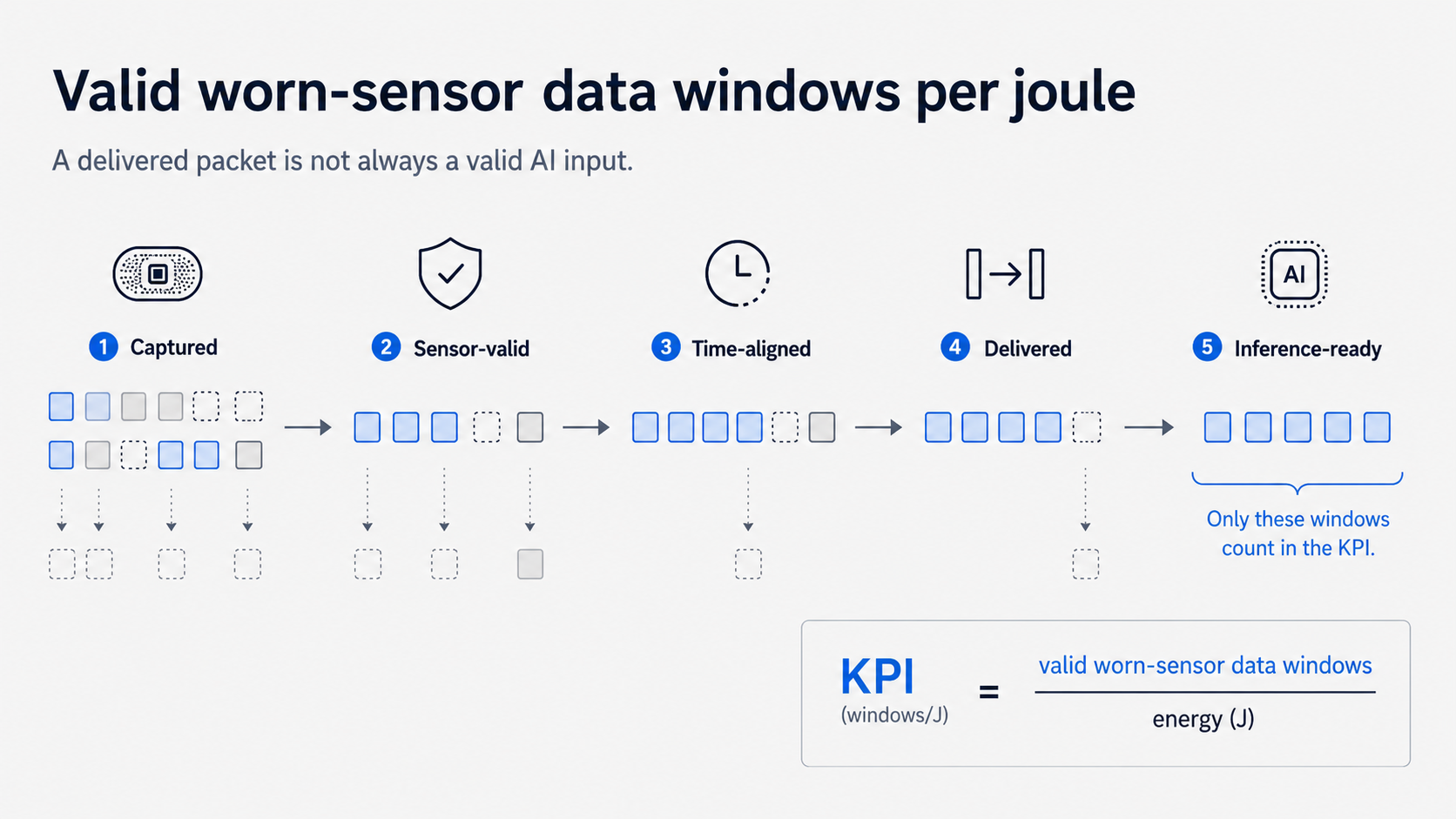
This pipeline defines a systems metric, not a statistical missing-data correction. Only windows that are sensor-valid, time-aligned, delivered on time, and inference-ready count toward valid-window yield.
Packet metrics are necessary and incomplete
Traditional connectivity benchmarks emphasize data rate, latency, packet delivery, range, and power. Those metrics still matter. But wearable AI needs one more layer of measurement.
A system should also be evaluated by:
Valid-window yield
What percentage of intended data windows are sensor-valid, synchronized, delivered, and usable?
What percentage of intended data windows are sensor-valid, synchronized, delivered, and usable?
Energy per valid window
How much energy does the system spend to produce each usable inference input?
How much energy does the system spend to produce each usable inference input?
Gap duration
Are missing windows short and manageable, or long enough to break model confidence?
Are missing windows short and manageable, or long enough to break model confidence?
Missingness by context
Do gaps appear during movement, sleep transitions, RF congestion, stress, low-battery periods, or overnight monitoring?
Do gaps appear during movement, sleep transitions, RF congestion, stress, low-battery periods, or overnight monitoring?
Multi-device time alignment
Can the wearable system synchronize data from the watch, ring, earbud, glasses, patch, and phone?
Can the wearable system synchronize data from the watch, ring, earbud, glasses, patch, and phone?
Auditability
Can the system preserve enough raw or semi-raw data to support confidence scoring, validation, and review?
Can the system preserve enough raw or semi-raw data to support confidence scoring, validation, and review?
These measurements connect connectivity directly to AI quality. They also make the product tradeoff clearer: a wearable system should not have to choose between richer AI and acceptable battery life.
What this KPI is and is not
| What this KPI is | What it is not |
|---|---|
| A systems metric for wearable AI data infrastructure | A statistical correction for missing data |
| A way to measure usable data yield per energy budget | A clinical endpoint |
| A way to compare link architectures under controlled conditions | A claim that missingness is random or non-random |
| A metric for capture, timing, delivery, and inference readiness | A substitute for missingness-aware modeling |
The energy denominator should always be reported with a boundary. For example, a link-level benchmark might measure valid windows per millijoule of communication energy only. A full-system benchmark would include capture, synchronization, buffering, and offload energy in the denominator. The boundary should be stated explicitly in every benchmark.
How to measure it
Once the measurement boundary is defined, valid-window yield can be evaluated before making model-performance claims.
| Measurement | What it asks |
|---|---|
| Intended windows | How many windows should the system have produced? |
| Sensor-valid windows | How many passed signal-quality checks? |
| Time-aligned windows | How many aligned across devices within the application tolerance? |
| Delivered windows | How many arrived before the inference deadline? |
| Inference-ready windows | How many were usable by the model? |
| Energy boundary | Was the denominator communication energy only, or full capture, synchronization, buffering, and movement energy? |
The cleanest comparison holds sensors, sampling policy, model, inference deadline, and application task constant, then changes the data path.
The result is not just packet delivery rate. It is usable data yield per energy budget.
Wearable data gaps have mechanisms
Missing-data researchers distinguish between mechanisms such as MCAR, MAR, and MNAR. In the strict statistical sense, Missing Not At Random, or MNAR, means the probability of missingness depends on unobserved information.
That distinction matters. This post does not claim that wearable gaps are always MNAR. It also does not claim that a connectivity layer can correct MNAR bias. The point is narrower: wearable systems lose usable windows through identifiable mechanisms, and some of those mechanisms are connectivity-addressable.
A gap caused by low battery, poor sensor contact, motion artifact, link instability, or delayed offload may be explainable from observed context. It may also hide the signal the model needed. Without a reference measurement or a missingness model, we should not casually label every gap as MNAR.
For wearable AI, the practical point is simpler: missing windows have causes, and some of those causes are addressable at the system-architecture level.
Wi-R BAN does not solve device removal, poor sensor contact, or every motion artifact. It targets a narrower but important part of the problem: the energy, reliability, and synchronization cost of moving data across person-worn devices.
A missingness-aware model and a better data path solve different problems. Missingness-aware models reduce the penalty of incomplete inputs. A lower-power person-worn data fabric reduces one source of incompleteness before the model sees it. The strongest systems will need both.
Episodic signals change the stakes
Not all wearable signals fail the same way.
For diffuse or aggregate signals such as average HRV, resting heart rate, step count, or general activity, missing windows may reduce confidence, but models can often smooth, interpolate, or learn around incomplete data.
For episodic signals, the failure mode is different.
An arrhythmia-relevant rhythm window, a sleep-stage transition, a short physiological stress response, or another transient event either appears in the sensor record or it does not. If the relevant window was not captured, not time-aligned, or not delivered before the application deadline, the downstream model cannot directly detect that event from the missing signal.
This is not only a model problem. It is an upstream data-path problem.
It is like asking a clinician to interpret a lab panel where several critical fields were never transmitted. The clinician can only interpret the record in front of them. A wearable algorithm works the same way: it cannot use a signal window that never reaches the model.
This is why the distinction between periodic screening and more continuous monitoring matters. Some consumer irregular-rhythm notification features are explicitly not continuous monitors and cannot detect every instance of AFib. That is not a criticism of those products. It is a reminder that product claims, sampling strategy, energy budget, and data-path design are inseparable.
Wi-R BAN does not make health algorithms better by itself. It improves the conditions under which those algorithms receive usable inputs. By reducing the energy and reliability cost of moving data across person-worn devices, Wi-R BAN can increase the number of valid windows available to the model, especially during workloads where continuous or overnight monitoring matters.
For aggregate health signals, algorithms can often tolerate some missingness. For episodic events, a missing window can erase the event from the record. If an event-relevant signal window is never captured, synchronized, or delivered, no downstream model can directly detect it.
Wi-R BAN attacks that failure mode upstream.
Wearables are becoming coordinated sensing systems
Wearables were originally built as mostly independent devices: a watch measured activity, a ring measured sleep, earbuds played audio, a phone acted as the hub, glasses displayed information, and patches handled specialized monitoring.
Wearable AI changes that architecture. The value is no longer locked inside a single device. It comes from combining multiple streams into a synchronized wearable sensor graph.
That shift creates a different set of connectivity requirements:
- Low energy per delivered data window
- Low latency across person-worn devices
- Reliable multi-device synchronization
- Reduced dependence on congested RF bands
- Localized communication close to the wearer
- Enough bandwidth to move raw or semi-raw data when confidence and auditability matter
Bluetooth, Wi-Fi, NFC, and other RF technologies are excellent for many jobs. They are widely deployed, mature, and essential to today’s ecosystem.
But sustained, localized, multi-device AI creates a different optimization problem. Basic connectivity is no longer the hard part. The harder problem is keeping several person-worn devices synchronized and data-rich without turning the battery into the limiting constraint.
Wi-R BAN: a worn-device data fabric for wearable AI
Solving this problem requires more than another software layer. It requires a physical layer designed for person-worn systems from the start.
Ixana’s Wi-R™ BAN is designed for that role.
Wi-R BAN uses electric-field communication to create a wire-like connectivity link for phones, wearables, medical devices, AR devices, and soldier systems. Instead of relying on conventional far-field RF behavior, Wi-R BAN is designed to keep communication localized around the wearer.
The goal is straightforward: move more valid wearable data with less energy.
Wi-R BAN is built for low-power, low-latency, localized communication, with:
- 5 Mbit/s data rate
- <1 mW power at 5 Mbit/s
- <1 ms latency
- Up to 100x lower power than BLE-class links for person-worn connectivity workloads in Ixana reference comparisons
- Up to 15 m range along the wearer
- ~0.1 m field confinement beyond the wearer
Those specifications matter because wearable AI does not need occasional connectivity only. It needs a data fabric that can support richer sensing, tighter synchronization, and more sustained context without making battery life the bottleneck.
For a deeper technical overview, read Ixana’s Wi-R Technology White Paper.
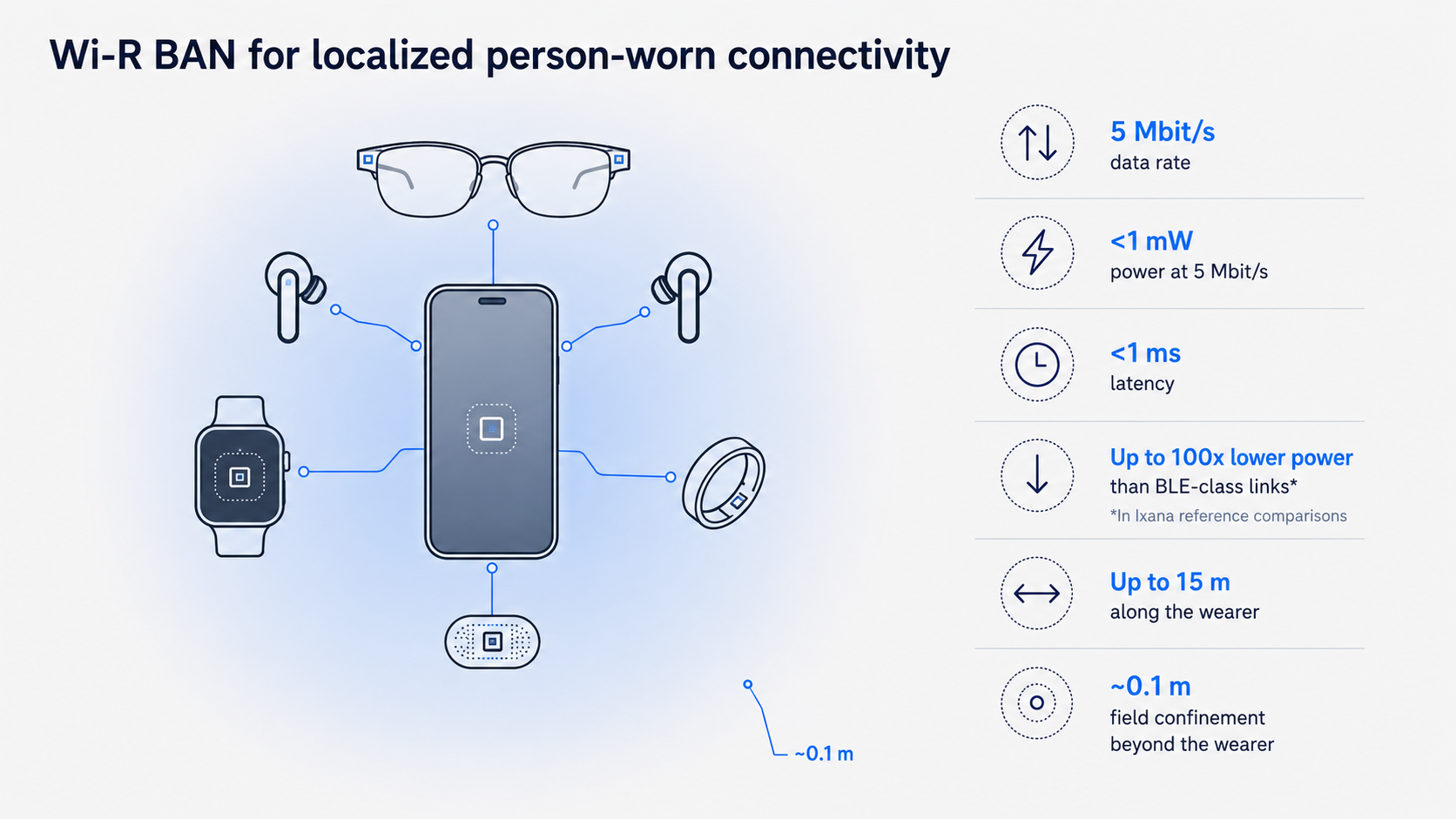
Wi-R BAN is designed for localized, low-power, low-latency connectivity across person-worn devices, with field confinement close to the wearer.
Which missingness mechanisms can connectivity improve?
Not every missing or invalid window has the same cause. Some causes are mechanical. Some are behavioral. Some are sensor-related. Some are connectivity-related.
Wi-R BAN does not eliminate missing data. No connectivity layer can.
But it is designed to reduce the communication, power, and synchronization costs that turn intended windows into missing or unusable inputs.
| Source of missing or invalid data | Connectivity-addressable? | Why it matters |
|---|---|---|
| Communication energy limits | High | Drives duty cycling and lost windows |
| Link instability, congestion, or wearer occlusion | High | Creates delivery gaps during real-world use |
| Multi-device synchronization gaps | High | Weakens sensor fusion |
| Local buffering and delayed offload | Medium to high | Reduces real-time context |
| Sensor duty cycling caused by system power pressure | Medium | Can reduce usable capture time |
| Motion artifact | Partial | Auxiliary streams may help identify artifacts, but connectivity does not remove the artifact itself |
| Poor sensor contact or sensor-surface fit | Low | Mostly a mechanical and product-design issue |
| Device removal or charging | Low | Mostly a user-behavior and battery-management issue |
This table is intentionally conservative. It shows where a lower-power data fabric can help and where other design choices still matter.
The claim is not that Wi-R BAN fixes wearable missingness. The claim is that Wi-R BAN can improve the connectivity-addressable part of valid-window yield.
Four places this matters first
1. Smart glasses need a fabric, not just a hub
Smart glasses are pushing wearable AI toward always-available context. But glasses alone are constrained by battery, thermals, form factor, and compute.
A phone can act as the AI hub. The glasses can provide the interface and selected context. Other wearables can contribute motion, physiological, gesture, audio, and environmental signals.
That architecture needs a low-power data fabric around the wearer. It needs more than occasional pairing. It needs fast, local, synchronized data movement across devices that are already being worn.
Wi-R BAN enables a new way to think about smart glasses: not as an isolated device, but as part of a coordinated wearable AI system.
2. Health AI needs synchronized sensors, not isolated devices
The future of wearable health will not depend on a single sensor location.
A watch may capture activity and heart-rate trends. A ring may capture sleep and temperature. Earbuds may contribute motion, audio, or physiological signals. A patch may provide higher-fidelity measurements. A phone may fuse the data and run the assistant.
The challenge is not only measuring these signals. It is keeping them usable together.
That means maintaining synchronization, reducing gaps, preserving confidence, and moving the right amount of data without forcing every device to spend more energy on communication.
For health-AI teams, the value is not simply more data. It is more valid, time-aligned, model-usable data.
3. Clinical research needs usable windows, not just device uptime
Clinical research depends on usable data. In wearable-enabled studies, missing or invalid sensor windows can reduce participant-level data yield, complicate downstream analysis, and reduce confidence in study data completeness.
The issue is not just whether a device collected something. The issue is whether it collected enough valid, time-aligned, auditable data to support the analysis.
A lower-power worn-device data fabric can help research systems preserve more usable sensor windows without forcing every sensor node to spend more energy on communication. That can matter for digital biomarkers, remote monitoring workflows, and studies where completeness and auditability affect confidence.
Wi-R BAN does not replace clinical validation, study design, or algorithm development. It gives those systems a stronger connectivity foundation.
Working on wearable-enabled studies or digital biomarkers? Contact Ixana to evaluate Wi-R BAN for higher-yield, auditable sensor-data capture.
4. In the field, every link has a signature
Defense systems face a stricter version of the same problem.
Soldiers carry electronics across many worn locations, often in harsh, mobile, RF-constrained, and contested environments. Cables add weight, snag risk, and integration complexity. Conventional RF links can face congestion, policy constraints, detectability concerns, or reliability challenges.
More continuous physiological data capture in this environment needs more than a generic wireless link. It needs localized, low-power, person-worn connectivity that can support mission equipment without adding unnecessary burden.
For soldier systems, valid worn-sensor data windows per joule can translate into fewer blind spots, less cabling, lower power demand, and better human-system awareness.
Better models still need better data paths
The industry will continue to build better wearable models. That is necessary.
But missingness-aware AI and better person-worn connectivity are not competing ideas. They are complementary. A better model can tolerate imperfect data. A better data fabric can reduce the amount of imperfection the model has to tolerate.
The strongest systems will use both. They will capture more usable sensor data, synchronize it more reliably, and run better models on top of it.
A wearable system that captures the right windows, at the right moments, with less energy overhead will produce more reliable intelligence.
The next wearable platform is the person-worn network
Wearable AI is not just about adding sensors. It is about turning person-worn devices into a coordinated platform for intelligence.
That requires a physical layer built for wearable systems: low power, low latency, localized, and designed for sustained multi-device communication.
That is what Wi-R BAN is built to provide.
The future of wearable AI will not be measured only by sensor count, model parameters, processor TOPS, or battery size. It will be measured by how reliably a system understands the person using it.
And that starts with a practical systems KPI:
valid worn-sensor data windows per joule.
Ixana is working with wearable, AR, medical-device, and defense partners to evaluate Wi-R BAN as the worn-device data fabric for the next generation of AI-enabled products.
To explore Wi-R BAN for your architecture, read the Wi-R Technology White Paper or contact Ixana for a technical briefing.
The best model in the product cannot use a signal that never arrives.
Further reading
- Missing-data mechanisms: MCAR, MAR, and MNAR
- Google Research: LSM-2 and incomplete wearable sensor data
- FDA: Apple Irregular Rhythm Notification Feature De Novo summary
- Apple: Heart health notifications on Apple Watch
- FDA guidance on digital health technologies for remote data acquisition in clinical investigations
Wearable AIWi-RWi-R BANElectric Field CommunicationSensor Data QualityValid Worn-Sensor Windows

Ixana Team
Developing ultra-low-power near-field wireless technology for the next generation of mobile and wearable devices.
Illustrative use case only. This page describes example workflows and interoperability concepts involving Ixana Wi‑R technology and third-party systems. Unless expressly stated otherwise, Ixana provides communications silicon, circuit boards and firmware components for E-field based body-area-network and near-field data transfer and is not offering complete medical device, clinical triage system, or finished end products.