Jun 29, 2026Ixana Team5 min read
What a Smart Ring Reveals About Wireless Power
What the Samsung Galaxy Ring reveals about wireless power budgets, and how Wi-R cuts radio current 15x compared to Bluetooth in smart rings.
Smart rings are a brutal battery-life test.
A phone carries thousands of milliamp-hours. A smartwatch carries a few hundred. A smart ring carries only tens.
Samsung's Galaxy Ring is a useful reference point. Its battery ranges from 17 mAh to 22.5 mAh, depending on size. Sizes 8 through 11 use an 18.5 mAh cell and are rated for up to 6 days on a single charge.
Spread across six days, that 18.5 mAh gives the entire device an average current budget of about 128 µA.
That budget has to cover everything: sensors, processor, memory, firmware, LEDs, power management, and the wireless link.
So the design question is simple:
How much of that budget should wireless communication be allowed to take?
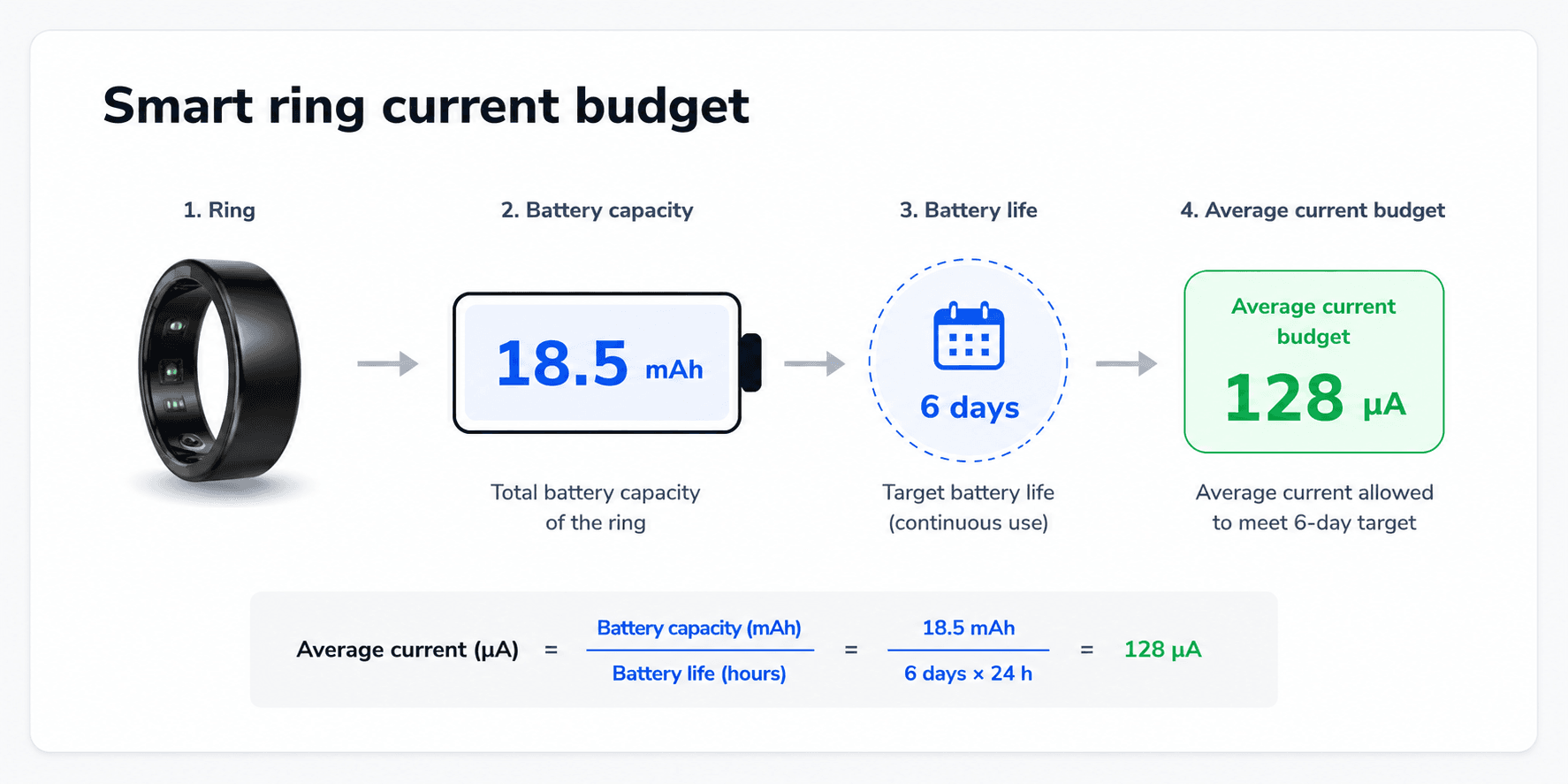
A smart-ring battery budget
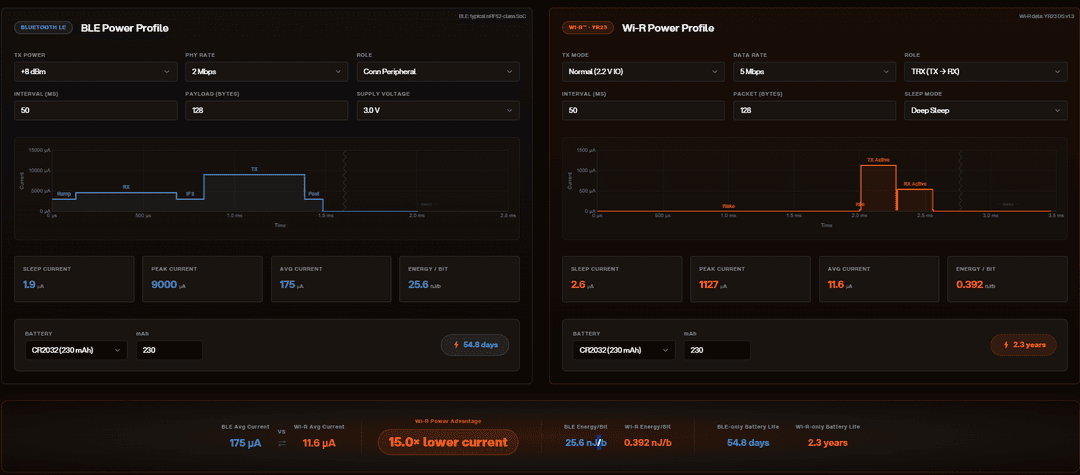
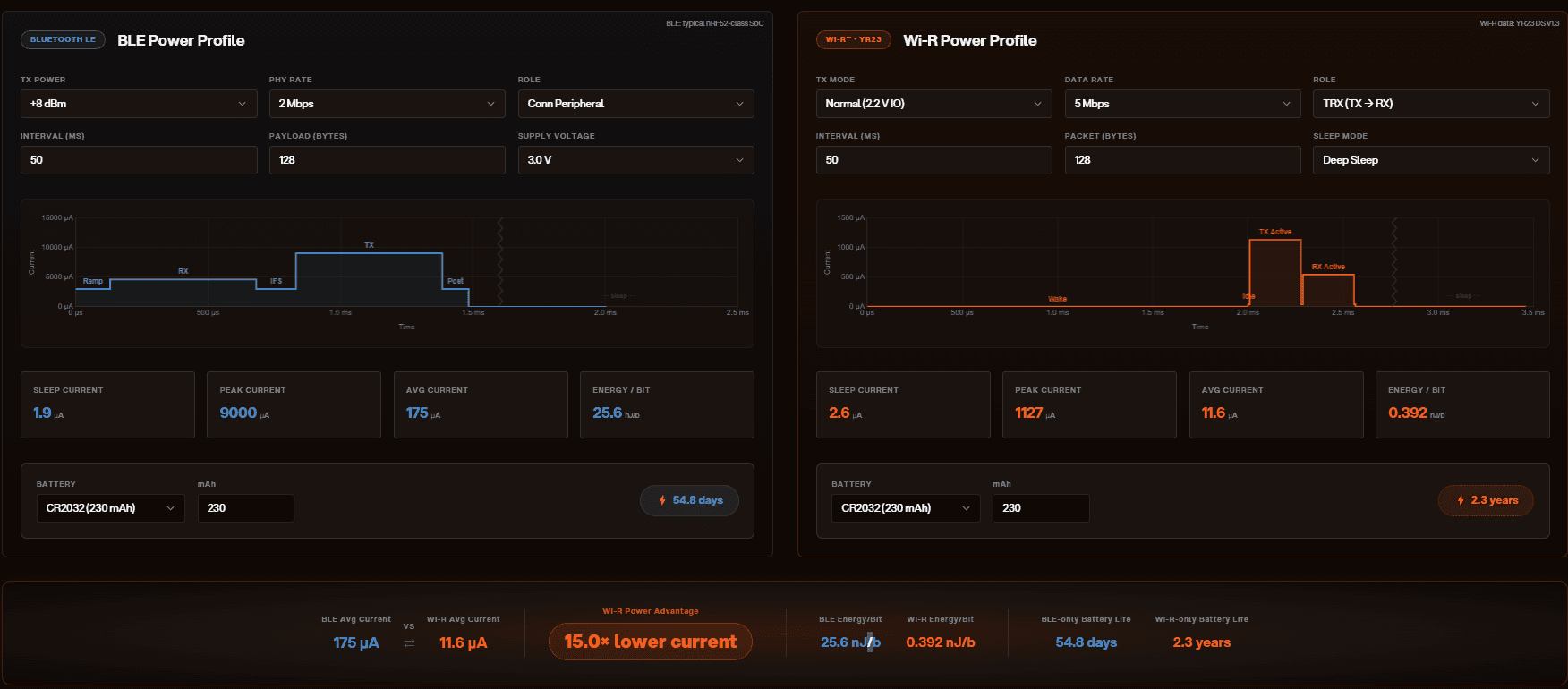
The Ixana Wi-R Power Profiler compares average current and battery life between Bluetooth LE and Wi-R. The currently displayed profiler operating points show a Bluetooth LE profile based on a typical nRF52-class SoC and a Wi-R YR23 profile based on YR23 datasheet data.
Applying those displayed current numbers to an 18.5 mAh smart-ring-class battery gives the following link-only comparison:
| Link profile | Profiler average current | Link-only runtime on 18.5 mAh | Profiler energy per bit |
|---|---|---|---|
| Bluetooth LE profile | 175 µA | ~4.4 days | 25.6 nJ/bit |
| Wi-R YR23 profile | 11.6 µA | ~66 days | 0.392 nJ/bit |
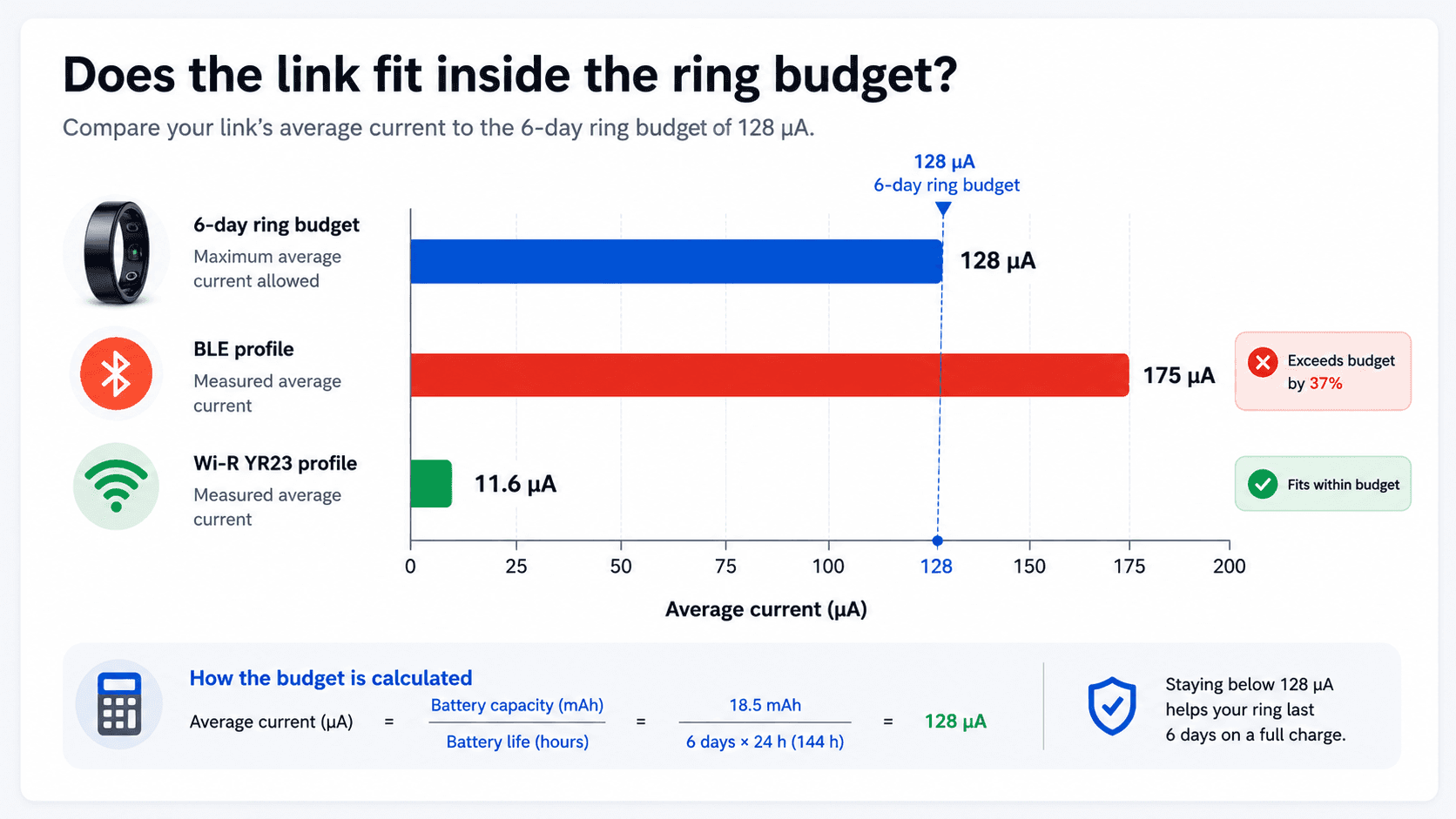
This is not a teardown of the Galaxy Ring's actual radio behavior. It is a product-level budget comparison: take a real smart-ring-class battery, then apply the wireless current profiles shown in the Power Profiler.
Over a six-day target, the selected BLE operating point would integrate to about 25.2 mAh of link-related charge. That exceeds the nominal 18.5 mAh capacity of a mid-sized Galaxy Ring battery before the ring has powered a single sensor or processor cycle.
The Wi-R YR23 operating point would draw about 1.7 mAh over the same six days, or roughly 9% of the same battery budget.
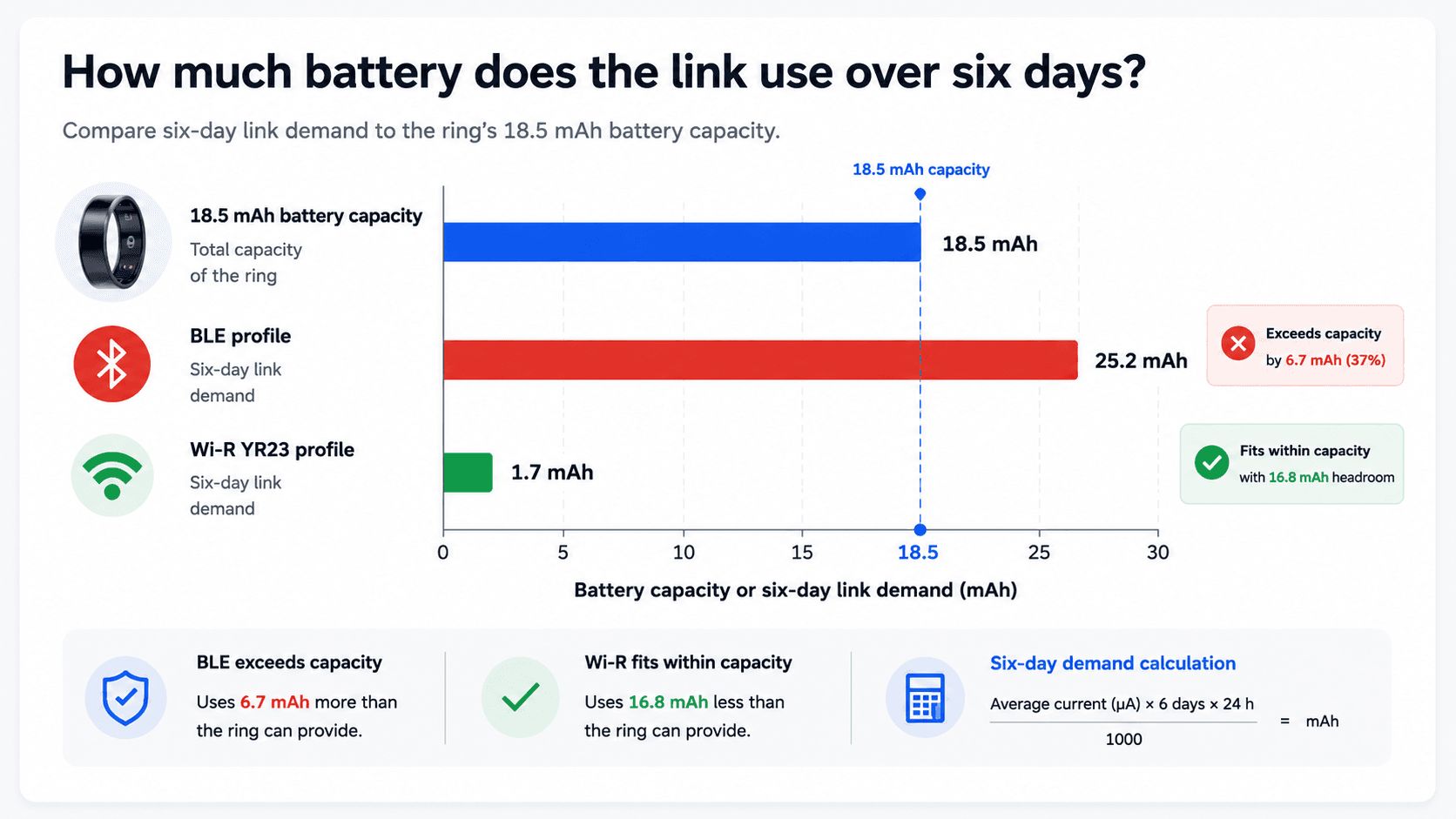
Current determines whether the link fits inside the battery. Energy per bit shows the other side of the tradeoff: how much it costs to move data under the selected operating point. In the displayed profiler comparison, Wi-R uses 15.1× lower average current and roughly 65× lower energy per bit than the BLE profile.
Why this matters
For a smart ring, lower wireless power does more than extend battery life. It changes what the product can afford to do.
A lower-power link frees current for more frequent syncs, richer sensing, and less aggressive data buffering. It makes coordination with a phone, watch, earbuds, or glasses cheaper to sustain. It also gives designers more room to spend the reclaimed budget elsewhere: a smaller battery, a thinner form factor, or more capable sensors.
That is the point of the Power Profiler.
It turns wireless power from an abstract spec into a design constraint you can test. Pick a battery. Set the link profile. See whether the communication budget fits the product.
For smart rings, wearable AI devices, medical patches, earbuds, and AR accessories, that question matters more than peak data rate alone.
The best wireless link is not just the one that connects. It is the one that leaves enough battery for the rest of the product.
Try the Ixana Wi-R Power Profiler to compare BLE and Wi-R operating points against the battery budget your device actually has.
Now plug in your own ring or wearable specs and run the numbers → Try the Power Profiler
Wi-RPower ProfilerSmart RingsWearablesBattery Life

Ixana Team
Developing ultra-low-power near-field wireless technology for the next generation of mobile and wearable devices
Illustrative use case only. This page describes example workflows and interoperability concepts involving Ixana Wi‑R technology and third-party systems. Unless expressly stated otherwise, Ixana provides communications silicon, circuit boards and firmware components for E-field based body-area-network and near-field data transfer and is not offering complete medical device, clinical triage system, or finished end products.