Jul 7, 2026Ixana Team10 min read
Physical AI Needs a Local Interconnect
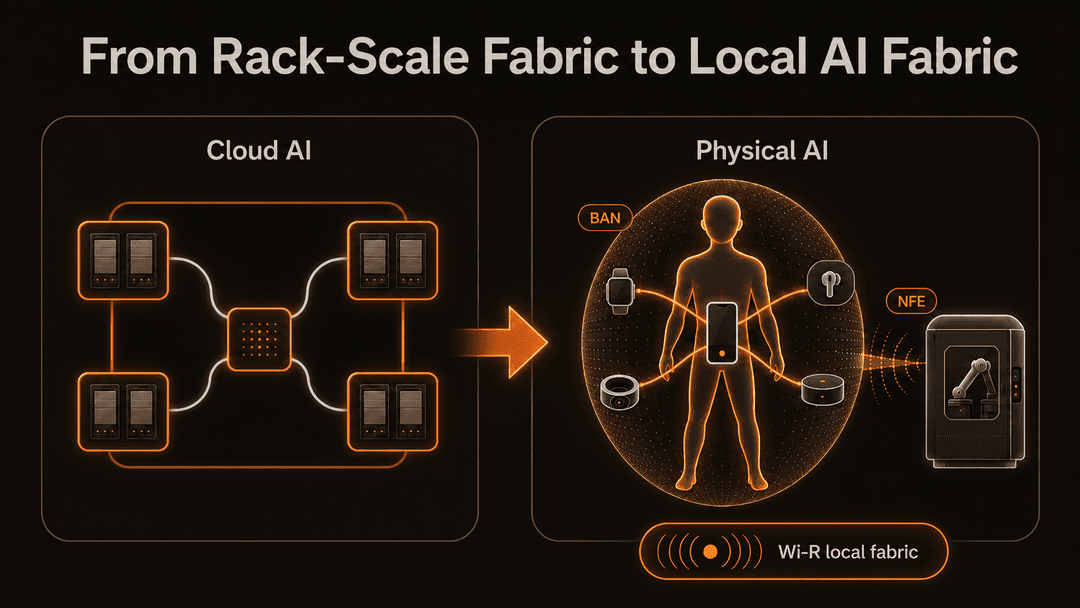
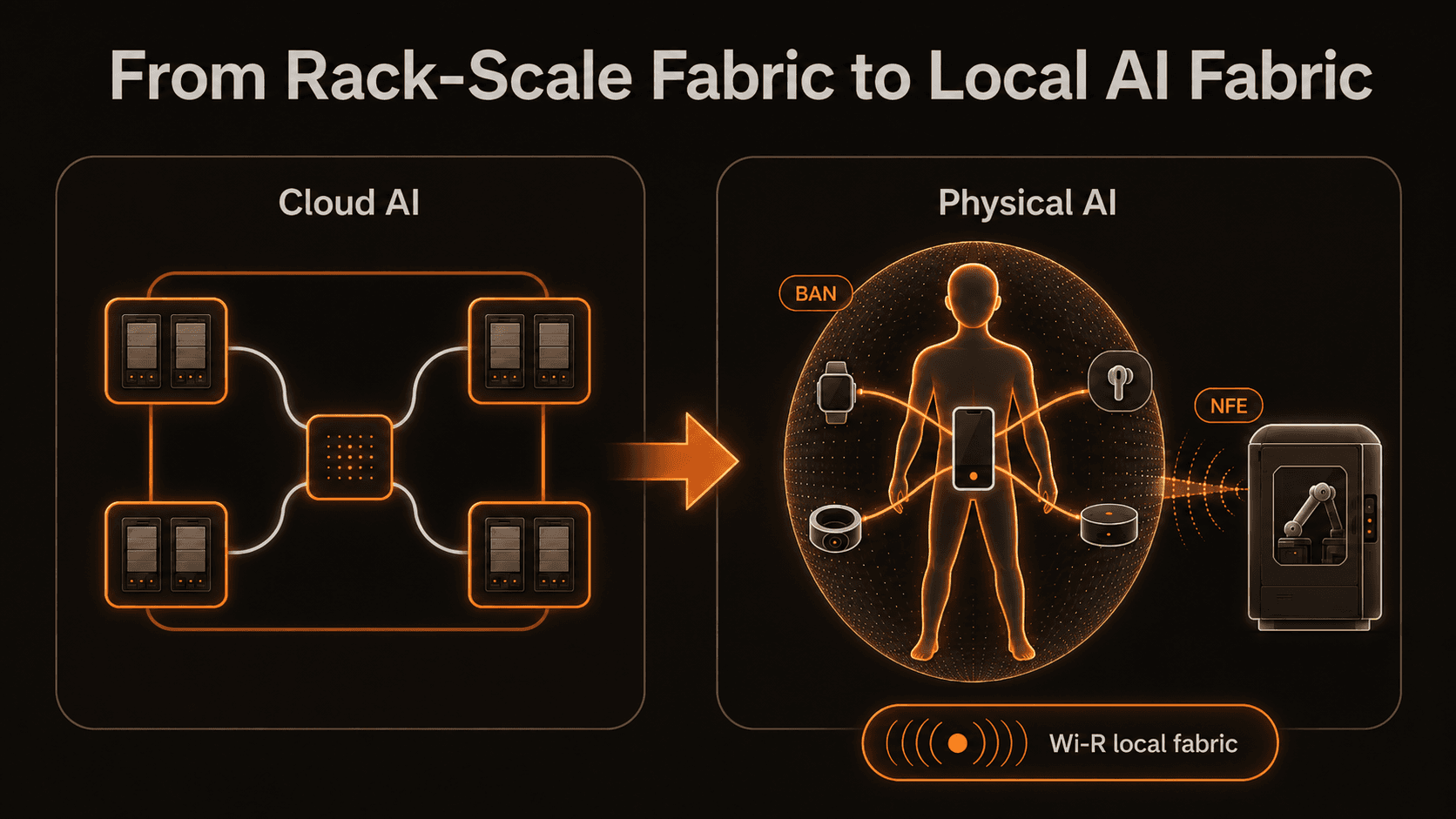
Why cloud AI has rack-scale fabrics while Physical AI needs a local interconnect to move data efficiently across bodies, wearables, and nearby compute.
AI infrastructure is entering a fabric-first era.
In the first wave, the question was how much compute a system could deliver. In the current wave, the harder question is how efficiently that system moves data across memory, accelerators, racks, and networks.
The data center optimizes for tokens per watt. Physical AI will increasingly be judged by local intelligence per joule.
That is why cloud AI is no longer designed around a chip in isolation. It is designed around memory, packaging, networking, and system-level interconnect. NVIDIA's Blackwell Ultra architecture makes the point: 8 TB/s of HBM bandwidth per GPU, NVLink 5 at 1.8 TB/s of bidirectional bandwidth per GPU, and 72-GPU NVL72 rack-scale configurations with 130 TB/s of aggregate bandwidth [1].
The market has already recognized the shift. Ayar Labs announced a $500M Series E for co-packaged optics [2], Kandou AI announced a $225M oversubscribed Series A for AI connectivity [3], and Nexthop AI announced a $500M Series B for AI networking [4].
But most AI interconnect discussions still center on the data center.
The next question is what the interconnect layer looks like when AI leaves the rack and moves onto bodies, wearables, smart glasses, sealed machines, robots, and nearby compute.
This is not a speculative device layer. Global wearable shipments totaled 145.7M units in Q1 2026 and are forecast to reach 693.2M by 2030 [5]. Within that base, smart glasses are emerging as an AI-native endpoint: shipments grew 167% year over year in Q1 2026 to approximately 2.25M units, with IDC forecasting 13.6M units in 2026 and 27.3M by 2030 [6].
The device base for physical AI is forming. The local interconnect layer has not yet been treated as first-order AI infrastructure.
The Bottleneck Moves to the Physical Edge
Cloud AI needs high-bandwidth links across chips, boards, racks, and data centers. Physical AI needs something different: efficient local links across centimeters and meters.
These links connect sensors, phones, wearables, medical devices, smart glasses, robots, sealed machines, and nearby compute. The design goal shifts from reach to locality: moving useful data with less energy, lower latency, and less unnecessary signal exposure.
In the cloud, locality means keeping data close to compute: in memory, on package, on board, or inside a rack-scale fabric. At the physical edge, locality means keeping data close to the body, device, or machine that needs it.
A data center can add power, cooling, switches, optics, racks, and redundancy. A wearable cannot. A smart glasses form factor cannot simply add more battery and more radios without changing weight, heat, and user experience. A sealed industrial device cannot assume an exposed service port. Medical, defense, factory, and robotics environments cannot always assume that broad-area wireless is available, desirable, or allowed.
Physical AI is not just an AI model running near the edge. It is a full system: sensors, compute, storage, identity, security, power, actuation, and communication. The local link is not a peripheral feature. It is part of the AI architecture.
The Phone Becomes the Body's AI Hub
The smartphone is the natural hub for body-edge AI.
It already has the battery, compute, secure storage, display, cellular connection, application ecosystem, and user permission model. Around it, a new constellation of devices is forming: watches, rings, earbuds, glasses, patches, badges, medical sensors, controllers, and other body-worn systems.
Today, many of these devices operate as disconnected islands. They sync periodically, stream selectively, or depend on links designed for general-purpose connectivity rather than continuous body-area intelligence.
Physical AI changes the value of that data. A body-edge AI copilot may need continuous context from motion, health, audio, identity, device state, environmental signals, and user intent. The value comes from fusing those streams locally and continuously, not from occasionally syncing one device at a time.
For the phone to become the body's AI hub, surrounding devices need communication that is fast enough for real-time interaction, low-power enough for small batteries, physically local enough to reduce unnecessary exposure, and simple enough to disappear into the user experience.
Conventional Wireless Was Not Built for Continuous Edge AI
Bluetooth, Wi-Fi, NFC, and cables each solve important problems. None is the complete local fabric for continuous physical AI.
Wi-Fi is built for network access and throughput, but many body-area and sealed-device applications cannot afford its power profile or room-scale RF behavior. Bluetooth is widely adopted and useful for low-power peripherals, but continuous higher-rate wearable sensing creates a different requirement: more local, lower-latency, lower-energy data movement.
NFC is excellent for tap interactions, authentication, and payments, but it was not designed for fast movement of large local payloads, firmware, logs, or rich sensor streams. Cables provide reliability and power, but they add connectors, mechanical failure points, sealing challenges, assembly complexity, and friction for users and technicians.
Physical AI needs another class of link: local by design, efficient by physics, and fast enough for real-time edge intelligence.
Wi-R Is a Local Fabric for Physical AI
Wi-R is Ixana's electric-field-based technology for low-power local communication. Instead of treating every wireless connection as a room-scale RF broadcast, Wi-R is designed to keep link energy local.
At publication, Wi-R BAN materials described a body-area link for phones, wearables, medical devices, and AR systems, with a 5 Mbit/s data rate, under 1 mW at 5 Mbit/s, sub-1 ms latency, 0.1 m signal confinement around the wearer, and about 50x lower energy per bit than Bluetooth [7].
September 2026 update: Ixana's current homepage uses a narrower named comparison: Wi-R at 5 Mbit/s, approximately 0.2 nJ/bit, full-chip active TX/RX average, compared with a Nordic nRF54L15 at Bluetooth LE 2M and +4 dBm. The resulting 38× figure and the earlier figure use different comparison definitions and should not be treated as interchangeable.
That matters because body-edge AI is constrained by battery size, heat, form factor, and continuity. A high-power link on a wearable does not merely shorten battery life. It limits the product architecture itself.
Wi-R NFE extends the same local-interconnect principle to close-range device communication. NFE materials describe contained electric fields that couple powered devices at close range, creating physically local links for provisioning, service, diagnostics, sealed devices, and local data transfer without room-scale broadcast [8].
These two deployment modes map to the two physical AI wedges in this post. Wi-R BAN targets continuous body-area networks around people. Wi-R NFE targets close-range links for machines, devices, and sealed systems.
At publication, Wi-R was implemented in Gen-3 silicon, with 14 completed tapeouts and developer kits shipping for evaluation and OEM integration [9]. The current homepage record now reports 15 across the displayed silicon history; the company execution metric separately reports 4 silicon tapeouts completed in 2026.
Machines Need Local Links Too
The same local-interconnect problem exists beyond the body.
Products are going portless. Robots, drones, medical devices, vehicles, industrial controllers, smart-home devices, and defense systems increasingly need setup, provisioning, firmware transfer, log extraction, maintenance, and access control without exposed ports or broad wireless setup flows.
Near-field local communication changes the model. A technician can bring a service device near a sealed machine. A robot or drone can offload logs without removing storage. A medical device can transfer data without relying on hospital Wi-Fi. An industrial system can be provisioned in environments where broad wireless access is restricted.
As machines become more intelligent, they will need more local data movement, not less.
Local Intelligence per Joule
Cloud AI already has system-level efficiency metrics: tokens per second, tokens per watt, and tokens per dollar.
Physical AI needs its own system metric:
How much useful local context can move per joule?
That question is more important than raw throughput alone. A physical AI system does not win by sending every signal as far as possible. It wins by moving the right data over the shortest practical distance with the lowest energy, lowest latency, and strongest system-level reliability.
For body-edge AI, that means longer continuous sensing, lower heat, and tighter coordination across wearables. For machines and constrained environments, it means local service, provisioning, diagnostics, and control that match the physics of the deployment.
The metric is not just bandwidth.
It is local intelligence per joule.
The Missing Layer in AI Interconnect
Cloud AI exposed the cost of moving data across racks. Physical AI will expose the cost of moving data across bodies, devices, and machines.
That does not mean local communication is the only bottleneck. Physical AI also depends on batteries, sensors, models, compute, safety, actuators, data, and deployment economics. But for continuous, low-power, real-time systems at the human and machine edge, local data movement becomes a first-order architectural constraint.
The AI interconnect wave has focused on the rack.
Physical AI needs the next fabric: local, low-power, low-latency links across the real world.
The data center optimizes for tokens per watt. Physical AI will increasingly optimize for local intelligence per joule.
Ixana is building that local fabric with Wi-R.
For anyone tracking the next layer of AI infrastructure, this is the missing physical-edge layer in the interconnect map. For product teams building AI wearables, smart glasses, sealed devices, robotics, or edge systems, the local link is now an architectural constraint.
Explore Wi-R BAN and Wi-R NFE, or reach out to discuss local interconnect architectures for physical AI systems.
References
[1] NVIDIA Developer Blog, "Inside NVIDIA Blackwell Ultra: The Chip Powering the AI Factory Era," 2025. Available: developer.nvidia.com
[2] Ayar Labs, "Ayar Labs Closes $500M Series E, Accelerates Volume Production of Co-Packaged Optics for AI Scale-Up," 2026. Available: ayarlabs.com
[3] Kandou AI, "Kandou AI Secures Strategic Funding to Redefine AI Connectivity and Break Memory Bottlenecks in AI," 2026. Available: kandou.ai
[4] Nexthop AI, "Nexthop AI Accelerates into Hypergrowth with Oversubscribed $500M Series B Funding," 2026. Available: nexthop.ai
[5] IDC, "Wearable Devices Market Insights," updated July 2026. Available: idc.com
[6] IDC, "Augmented and Virtual Reality Headsets Market Insights," updated July 2026. Available: idc.com
[7] Ixana, "Wi-R BAN: Body Area Network," 2026. Available: ixana.ai
[8] Ixana, "Wi-R NFE: Near Field Electric," 2026. Available: ixana.ai
[9] Ixana, "The Second Nervous System for Physical AI," 2026. Available: ixana.ai
Wi-R BANWi-R NFEPhysical AIAI InfrastructureInterconnectWearables

Ixana Team
Developing low-power near-field wireless technology for the next generation of mobile and wearable devices
Illustrative use cases only. Ixana provides communications silicon, circuit boards, and firmware components for E-field-based body-area and near-field data transfer.