Dec 15, 2025Ixana Team4 min read
Ixana Wins NATO Innovation Challenge for Low-Emission Touch-to-Triage Medical C2
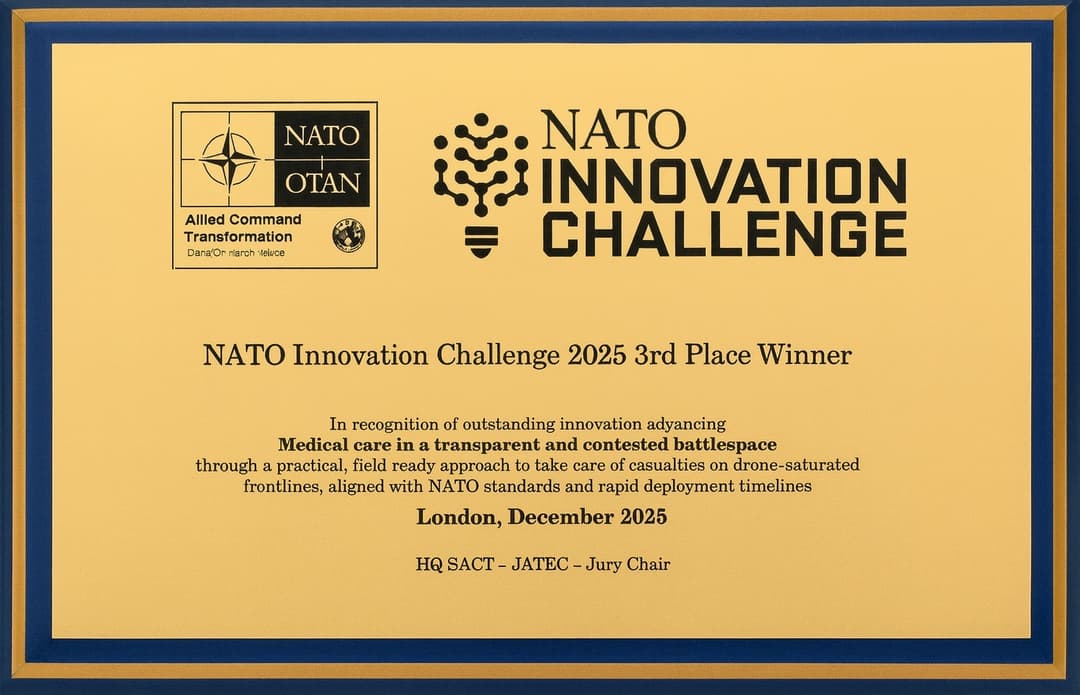
Ixana wins third place in the NATO Innovation Challenge for Touch to Triage: low emission medical data exchange for combat casualty care using Wi-R.
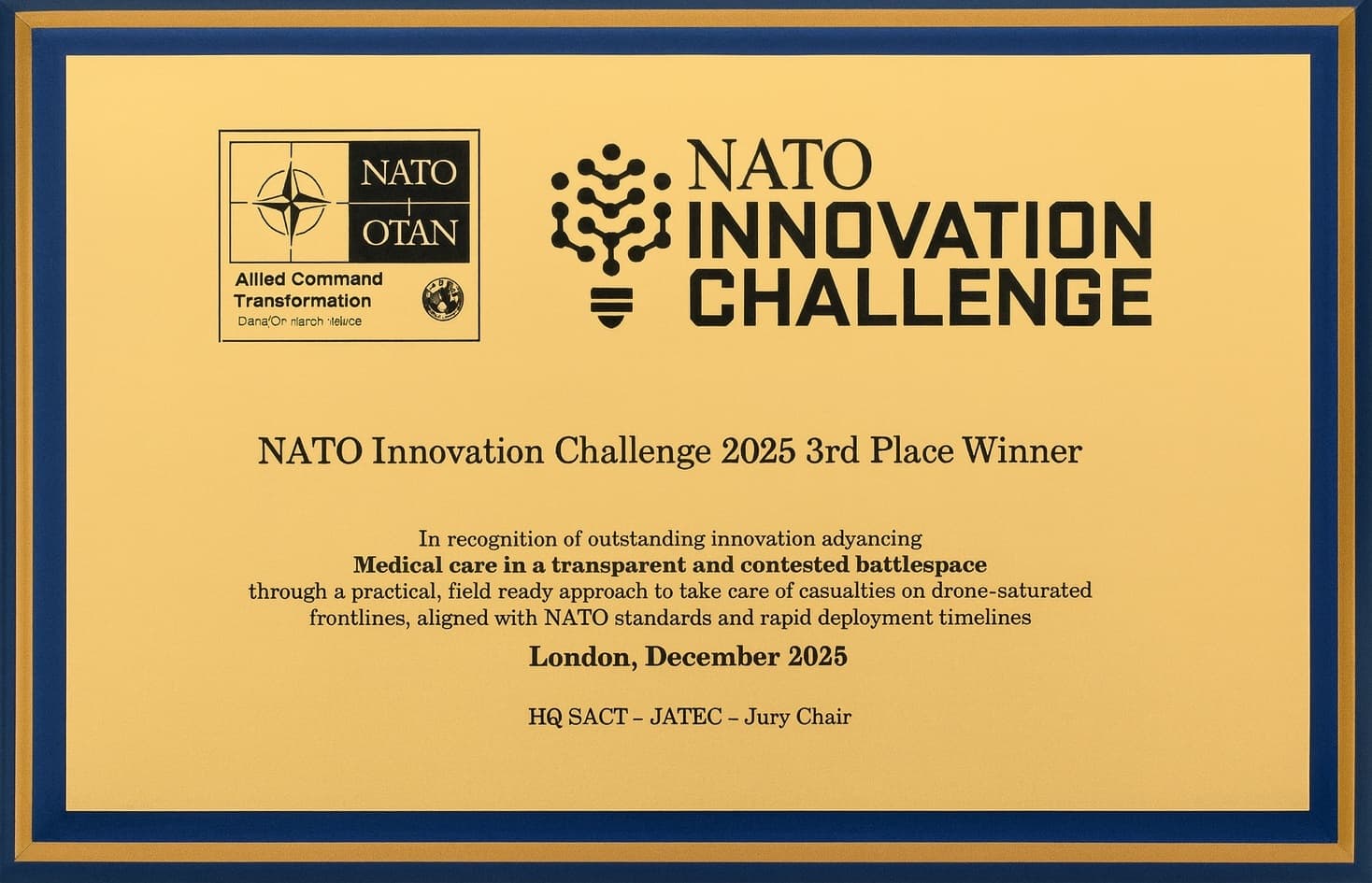
Touch-to-Triage: Ixana Wins NATO Innovation Challenge for Medical C2 in Jammed Environments
Ixana has been selected as a winner in NATO Allied Command Transformation’s 17th Innovation Challenge, a medical-focused challenge addressing one of the most urgent operational realities in modern conflict: delivering care and coordinating evacuation in a drone-saturated, heavily jammed battlespace.
The challenge, conducted in partnership with the NATO-Ukraine Joint Analysis, Training and Education Centre (JATEC), concluded in London with three international teams selected to move forward into rapid prototyping and engagement with NATO stakeholders. Ixana was awarded Third Place for its proposal on Low Probability of Intercept / Low Probability of Detection (LPI/LPD) Medical Command and Control, centered on a concept we call Touch-to-Triage.
The problem NATO put on the table
Recent conflicts have fundamentally altered battlefield medicine. Persistent aerial surveillance, electronic warfare, and precision fires increasingly delay casualty evacuation by 60 to 120 minutes, transforming the traditional “golden hour” into what is now often a “golden day.”
To address this, NATO framed the challenge around four core needs:
- Immediate care at the point of injury
- Concealed casualty collection points with reduced visual, infrared, and RF signatures
- Protected extraction over 1 to 5 km under active threat
- Medical command and control that functions in a contested electromagnetic spectrum, where GNSS and conventional radios are unreliable or restricted
The unifying constraint was clear: medical systems must work without turning patients or medics into detectable emitters.
Ixana’s approach: Touch-to-Triage Medical C2
Ixana’s winning solution enables encrypted, low-emission transfer of triage data and vitals using confined electric fields rather than radiating RF links.
Instead of relying on continuous over-the-air communication, Touch-to-Triage makes physical proximity and intentional contact the interaction primitive:
- A medic can retrieve triage data and vitals through a fast, local exchange.
- Communication occurs without persistent RF emissions that are easier to detect, jam, or operationally restrict.
- Critical medical coordination remains possible even when spectrum access is denied or degraded.
This approach targets the “last decimeter” problem of battlefield data movement: ensuring that essential information moves reliably at the moment it is needed, without expanding the electromagnetic signature.
Why electric-field communication fits battlefield medicine
Radiating wireless technologies are optimized for range. In modern combat, range is often the liability.
Ixana’s Wi-R technologies use localized electric fields that remain confined to the immediate vicinity of the wearer or devices. This confinement supports predictable behavior, low emissions, and inherent physical security.
Wi-R BAN for continuous wearable sensing
Wi-R BAN (Body Area Network) enables ultra-low power, wire-like connectivity between wearable devices such as wearables, sensors, and a smartphone or gateway. It supports continuous physiological monitoring without continuously broadcasting RF energy, aligning naturally with medical workflows that demand persistence without exposure.
Wi-R NFE for tap-based data exchange
Wi-R NFE (Near Field Electric) enables contact-range data transfer, where a tap or close proximity can trigger an automatic, high-speed exchange. Physical closeness becomes the security boundary, reducing pairing friction while maintaining operational discipline in denied environments.
Together, these two primitives allow continuous sensing on around the wearer and intentional, momentary data transfer off the wearer, exactly matching how triage and medical handoffs occur in practice.
Security that survives the threat horizon
Medical command and control is not only a connectivity problem but also a long-term data security problem. Casualty records, unit status, and operational timelines retain sensitivity well beyond the moment of capture.
Ixana’s architecture is designed to be post-quantum ready, pairing low-emission physical-layer communication with cryptographic protections suitable for long-lived data. Touch-based exchange reduces over-the-air exposure today, while quantum-resistant security addresses the risk of harvest-now, decrypt-later attacks in the future.
Why this recognition matters
NATO’s selection validates a core thesis behind Ixana’s technology roadmap:
As environments become more sensed, more jammed, and more contested, the most valuable communications are often the shortest-range ones that keep working under pressure.
The Innovation Challenge emphasized resilient medical command and control under spectrum denial. Ixana’s Touch-to-Triage concept directly addresses that gap by combining localized physics, low power operation, and intentional human interaction.
What comes next
NATO has indicated that the selected teams will work with Allied Command Transformation to advance their solutions toward rapid prototyping and field testing.
For Ixana, the next phase focuses on:
- Translating Touch-to-Triage into deployable medical workflows
- Validating performance in denied, degraded, intermittent, and limited environments
- Ensuring compatibility with coalition operations, signature management constraints, and real medic workflows
We are grateful for the recognition and excited to continue working with defense and medical stakeholders to bring resilient, low-emission connectivity to the point of care when it matters most.
For a deeper dive into specific field use cases, see Wi-R in Combat Medicine: Medically Transparent, Operationally Invisible.
DefenseNATOMedical C2Contested CommunicationsWearablesNear-Field Connectivity

Ixana Team
Ixana develops ultra-low power, private-by-physics connectivity for defense, industrial, and wearable systems.
Illustrative use case only. This page describes example workflows and interoperability concepts involving Ixana Wi‑R technology and third-party systems. Unless expressly stated otherwise, Ixana provides communications silicon, circuit boards and firmware components for E-field based body-area-network and near-field data transfer and is not offering complete medical device, clinical triage system, or finished end products.