Mar 25, 2026Shreyas Sen5 min read
Five Years of Ixana: Building the 21st Century Connectivity Fabric
Five years of Ixana, from first image transfer demo to a five device wearable network at CES 2026. The story behind Wi-R low power wireless silicon.
This month marks five years of Ixana. We officially celebrated our anniversary on March 18, exactly five years to the day since Shovan joined the team and our chip tapeout journey officially began.
Anniversaries are a chance to look back, but for us, they are also a reminder of how much work it takes to make a fundamentally new technology real. What began as an idea that many thought was impossible has, through relentless execution, become working silicon, live demonstrations, and a growing foundation for the future of connected computing.
Over the last five years, our team has grown to 75+ engineers, scientists, and builders united by a simple belief: the next era of computing will require a new connectivity fabric.
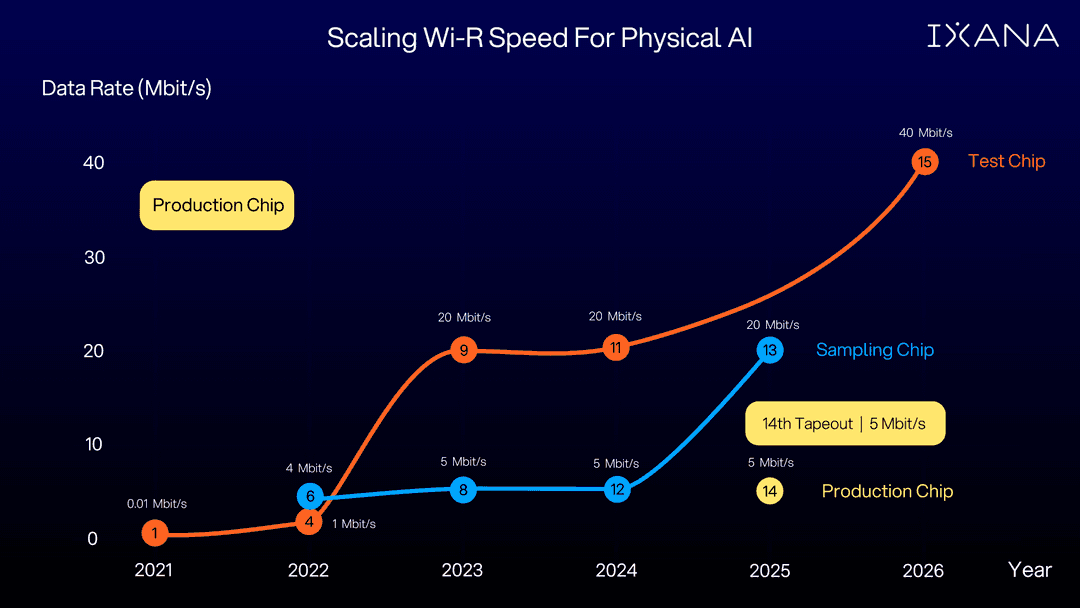
At Ixana, we have never set out to build just another chip. Our first act is to make Wi-R ubiquitous, a new class of connectivity designed to mimic the efficiency and speed of the nervous system to unlock the next era of human-AI collaboration. That vision has pushed us to move quickly and learn constantly. In an industry where a single tapeout can take years, completing 15 silicon chip tapeouts in just five years with a small chip design team is practically unheard of. We have scaled Wi-R from a theoretical concept to a 20 Mbit/s high-speed sampling chip, while demonstrating testing speeds up to 40 Mbit/s at our 15th tapeout (T15) milestone. We have done this while maintaining sub-millisecond latency and sub-milliwatt power consumption at Mbit/s speeds.
The Evolution of Wi-R in Demos
Our tapeouts are not just internal milestones; they translate directly into physical capabilities. Over the past five years, we have continuously proven new dimensions of what Wi-R can do.
2021: Feasibility
We demonstrated image information transfer with the chip from Tapeout 1 (T1), proving the fundamental feasibility of Wi-R communication. Many of our early investors and backers will remember this crude demo.
2022: Distance and Reliability
We achieved ~100kbps audio streaming from floor to head, demonstrating that unlike NFC, Wi-R can work reliably across the span of the human body.
2023: Intentional High-Speed Transfer
By communicating 1Mbps audio via touch, we demonstrated high-speed data transfer triggered by natural, intentional interaction.
2024: Bandwidth for Video
We unlocked B/W video streaming from a smart glass to a large-sized tablet, providing visual proof that our bandwidth and latency could support continuous streaming.
2025: Miniaturization and Consumer Readiness
By streaming B/W video from a smart glass to a small wristwatch, we proved the technology is feasible within the severe constraints of actual consumer wearables.
2026: The Distributed Network
At CES2026, we demonstrated a 5-device network, proving that Wi-R's ultimate strength lies in coordinating peer-to-peer data transfer across multiple devices via a hub.
That progress rests on deep technical innovation. Across communication, low-power sensing, approximate computing, and near-memory AI, Ixana has built a growing intellectual property portfolio of 45 filed and granted patents. Together, these innovations form the basis of a fundamentally different approach to connectivity and compute.
Strategic Traction
The market is beginning to validate that vision. Multiple companies have integrated our chip into their internal products and plan to launch later this year or early next year. Additionally, three defense primes have integrated our technology into their products. Recognition such as the CES Innovation Award has been an encouraging signal, but the clearest validation comes from seeing partners experience Wi-R firsthand. There is a moment in every live demo when skepticism gives way to belief. Those moments are what keep us pushing.
Real-World Impact
What excites us most is not just the technology itself, but what it makes possible in the real world. While massive scale is still on the horizon, two critical areas have already shown where Wi-R solves huge problems.
First, in mission-critical defense environments, soldiers still have cables for all their gear because Bluetooth and Wi-Fi cannot be used on the battlefront due to detectable emissions. Wi-R eliminates the burden of cables without relying on conventional wireless signals.
Second, on the consumer front, partners have realized that we finally have a connectivity fabric that enables real-time communication between the brain and AI devices on the body via distributed compute and charging-free devices. We believe this will become an essential building block for more natural human-device interaction.
The Engine: Our Team
None of this happens without the team. Building a hardware company is unforgiving work. It demands technical depth, speed, resilience, and a willingness to solve problems that have no playbook. The last five years are a testament to the people at Ixana who have chosen to do exactly that every day.
The Next Five Years
We are proud of what we have built so far, but we are even more energized by what comes next. The first five years were about proving Wi-R is possible. Over the next five years, Wi-R will be in most smartphones, wearables, robots, cars and drones realizing the vision of being the second nervous system for Physical AI.
To everyone who has helped us get here, including our team, partners, investors, and supporters, thank you.
We are just getting started.
IxanaWi-RNear Field ElectricPhysical AIDistributed Compute

Shreyas Sen
Founder & CTO of Ixana, Elmore Associate Professor of ECE & BME at Purdue, MIT TR35, TEDx, GT 40U40
Illustrative use case only. This page describes example workflows and interoperability concepts involving Ixana Wi‑R technology and third-party systems. Unless expressly stated otherwise, Ixana provides communications silicon, circuit boards and firmware components for E-field based body-area-network and near-field data transfer and is not offering complete medical device, clinical triage system, or finished end products.