Dec 26, 2025Ixana Team4 min read
The Last 30 cm Problem: Why Quick Share Needs a Confidence Layer
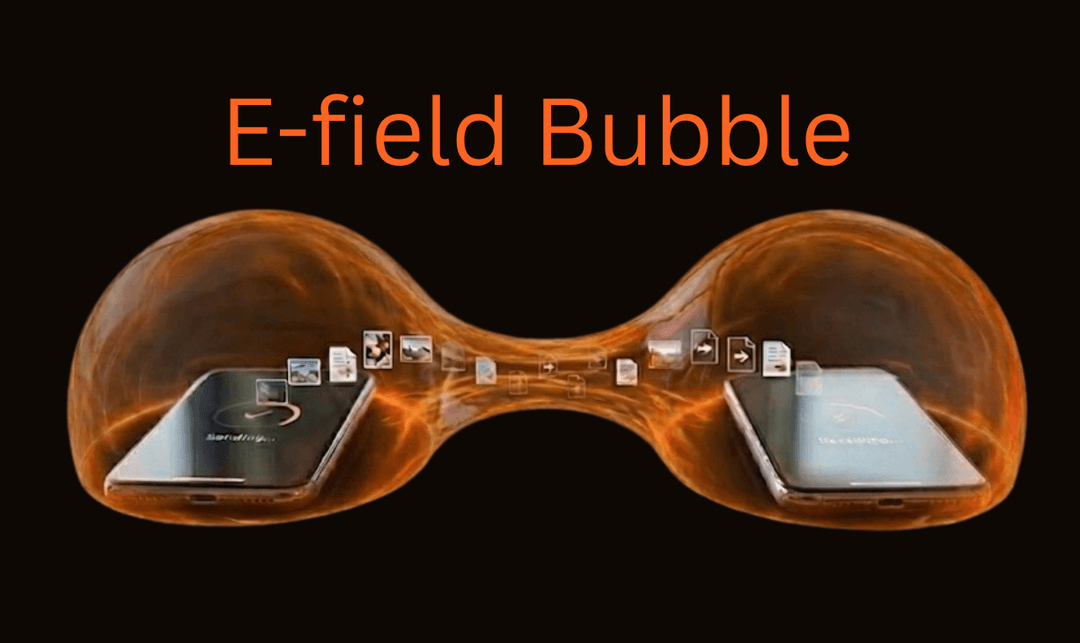
Why Android Quick Share struggles in the last 30 cm, and how a Wi-R NFE confidence layer confirms the right device for reliable close range sharing.
The Last 30 cm Problem: Why Quick Share Needs a Confidence Layer
AirDrop set the consumer benchmark for local sharing: it should feel immediate, deliberate, and effortless.
Android has a native equivalent (often surfaced as Quick Share, previously Nearby Share), but for many people it has not become a daily habit. The friction is not peak transfer speed. It is the first few seconds: discovery, intent, and confidence that you are sending to the right device. AirDrop is the consumer reference point for what 'local sharing should feel like,' and Android OEMs now have an opportunity to meet that expectation with a close-range confidence layer.
Radios designed for room-scale connectivity (Bluetooth and Wi‑Fi) are not great at answering one very human question:
"This device, right here. Not the other one."
That is why users still encounter scanning delays, lists of similar device names, and a workflow that often depends on the receiver being in the right state. In fact, Google's own instructions include checks like ensuring the other device is in Receive mode and that its screen is unlocked, which is a clear signal that initiation can be context-dependent.[1]
A hardware assist for the "last 30 cm"
The "software problem" of Quick Share is that it relies on radios optimized for broadcast and general-purpose discovery. The fix is a close-range physical layer that can confirm intent first, then hand off to the existing sharing stack.
That is the role of Wi‑R NFE (Near‑Field Electric).
Wi‑R NFE is a close-range link designed for centimeters to tens of centimeters. When two phones are brought close, it can provide a high-confidence "you meant this device" signal, without changing what Quick Share is or how it works when that close-range lane is not available.
Wi‑R NFE as a confidence layer for Quick Share
Wi‑R NFE does not replace Quick Share. It acts as a High-Confidence Initiation Layer:
-
Confirm the intended recipient at close range - Bringing devices close provides a deterministic intent signal, reducing ambiguous device lists and guesswork.
-
Carry small payloads, then hand off large transfers - Use the close-range link to exchange small payloads (for example, photos, contacts, setup tokens) and establish a trusted session quickly. For large files, seamlessly hand off to Quick Share's existing high-speed transport.
-
Graceful fallback, no ecosystem penalty - If the other phone does not support the close-range layer, the experience falls back to standard Quick Share. You keep today's compatibility and gain a premium interaction when both devices support the feature.
Why this matters to Android OEMs
In a market where many flagship specs converge, the interaction moments that happen every day are what shape brand perception.
For any OEM, a close-range confidence layer creates a signature experience in a high-frequency workflow: sharing photos, clips, and files in person. It also reduces the need for "rituals" like toggling visibility modes or repeating attempts in crowded environments.
It is also directly aligned with what Quick Share already asks users to do in troubleshooting flows: in some cases, Google's guidance for Quick Share on Windows explicitly tells users to bring devices within about 30 cm to improve sharing reliability.[2]
The KPI that matters
If you evaluate this feature, optimize for one metric:
First-try completion rate at close range - Measured end-to-end from "Share" to "Transfer complete," within a defined close-range interaction envelope.
That KPI maps to user trust, support load, and perceived quality far better than peak throughput claims.
What this means for integration
This is not a "new sharing app." It is a physical layer assist.
From a platform perspective, it is an additive close-range lane that can be integrated like other connectivity companion functions. If the system does not already have a suitable reference, the NFE device requires a 40 MHz crystal. (The rest of the integration is best validated in the target enclosure, like any close-range interaction feature.)
Next step
If you own product differentiation or Quick Share experience quality, the right next step is a side-by-side demo in a crowded RF environment, measured by first-try completion rate. The first platform to ship a close-range confidence layer for Quick Share will define the new baseline expectation for Android local sharing.
References
[1] Google Android Help: Quick Share instructions (Receive mode, unlocked screen, visibility modes). https://support.google.com/android/answer/15728591
[2] Google Android Help: Quick Share between Android and Windows (includes "bring the devices within … 30 centimeters"). https://support.google.com/android/answer/13801258
[3] Samsung Support: Quick Share discoverability behavior and how "everyone nearby" can become the default in some entry paths. https://www.samsung.com/us/support/troubleshoot/TSG10007273/
Wi-R NFEQuick ShareAndroidApplicationsSmartphone

Ixana Team
Developing ultra-low-power near-field wireless technology for the next generation of mobile and wearable devices
Illustrative use case only. This page describes example workflows and interoperability concepts involving Ixana Wi‑R technology and third-party systems. Unless expressly stated otherwise, Ixana provides communications silicon, circuit boards and firmware components for E-field based body-area-network and near-field data transfer and is not offering complete medical device, clinical triage system, or finished end products.