
Ultra‑Efficient WirelessBuilt for Human‑AI Collaboration
New E-field physics: 50x lower energy than Bluetooth, Wi-Fi or NFC. Wire-like speed and latency with confined signals. Enables always-on wearable and distributed edge AI with ultra-long battery life.
Wi-R: Wire-Like
Wireless
Wi-R is a fundamentally new wireless platform using contained electric fields for ultra-efficient, privacy-by-physics communication. Unlike radiated RF that spills in all directions, Wi-R links stay confined around the wearer or device, enabling physically local connections that power always-on wearable and edge AI.
- ✓
Ultra‑efficient (energy per bit)
- ✓
Real‑time (sub‑ms latency)
- ✓
Physically local (privacy by physics)

The E-Field Breakthrough
Learn how contained electric fields enable ultra-efficient, privacy-by-physics communication for wearables and edge AI.
Platform Advantages
Core Wi-R specifications enabling both body area networks and near-field exchange.
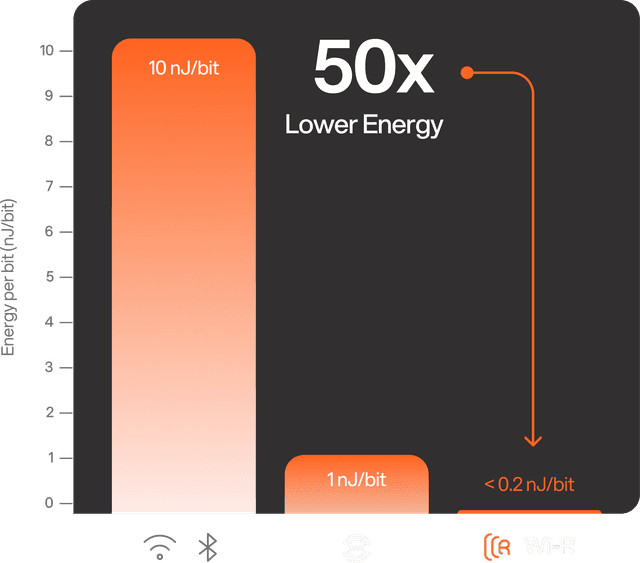
50x More Efficient
Wi-R achieves 0.1-0.2 nJ/bit energy efficiency, a decade better than Bluetooth, NFC, and other short-range wireless technologies. This enables all-day operation for continuous wearable AI, sensor networks, and high-speed streaming.

High-Speed Data
5-20 Mbit/s
Capable of continuous video streaming and real-time sensor data.

Ultra-Low Latency
<1 ms
Near-instantaneous response for real-time control and interactive applications.

Physically Secure
<1m confinement
Contained electric fields decay away from surface making signals physically secure.

Multi-Device Networks
Up to 16 devices
Simultaneous connections enabling complex body-worn sensor ecosystems and device clusters.
WHY NOW
Real-Time Wearable and Edge AI Demands Always-On, Ultra-Efficient Connectivity
AI is ready to become personal, an automatic extension of the brain, but tiny devices cannot host hot, watt-class NPUs next to the skin all day. The practical path is to keep sensors simple and lean on a central phone for compute, similar to how phones lean on the cloud for compute. That only works if the link is both fast and incredibly frugal. Conventional short-range radios burn too much energy at sustained rates or miss real-time deadlines.
Wi-R uses confined electric fields to deliver wire-like latency and 50-100x lower energy per bit. The result is continuous biometrics and on-device distributed AI that run for days or weeks on small batteries, without shouting into the air.
This foundation enables two complementary deployment modes: Body Area Networks (BAN) for wearables and continuous biometric streaming, and Near-Field Electric (NFE) for portless devices and sealed equipment.

Two modes of Wi-R
Select Wi-R BAN for wire-like data streams for wearables and Wi-R NFE for proximity communication in edge devices. Contact us for combo chip.
BODY AREA NETWORK
Wi-R BAN
E-field bubble for wearables, AR devices, and medical systems with wire-like responsiveness.
Range & Coverage
Up to 15m along surface with 0.1m confinement
Primary Use Cases
High-speed data streaming for long battery-life wearables
NEAR-FIELD ELECTRIC
Wi-R NFE
E-field bubble around devices for high-speed service links at sub-milliwatt power levels.
Range & Coverage
Configurable 5-25 cm range for near-field interactions
Primary Use Cases
Applications that need 10x faster, longer range, lower power than traditional NFC
BAN vs NFE: Pick the right mode
Real-world applications for Wi-R
Explore four proven scenarios and filter by the Wi-R mode best suited to your build.
Always-on health and fitness
Continuous biometric monitoring with week-long battery life using BAN to stream heart rate, glucose, and activity data.
All-day AR glasses
Offload compute to a paired phone for untethered AR and VR BAN keeps high-rate sensor fusion without heating headsets.
Continuous patient monitoring
Pair with NFE then stream with BAN to support wearable monitors, smartbeds, and bedside devices that stay compliant.
Portless device setup
Provision smart thermostats, locks, and appliances on-site without Wi-Fi credentials by tapping with NFE.
Wi-R platform roadmap
Current products and research programs across the Wi-R platform.
Wi-R BAN
BODY AREA NETWORK
- •YR23 (5 Mbit/s)
- •YR31 (20 Mbit/s target Q1 2026)
- •Video streaming and sensor fusion
Technical resources
Download the latest BAN and NFE documentation along with integration guidance.
FAQ at a Glance
Find quick answers to the most frequently asked questions about our services, products, or policies here.
Wi‑R uses contained electric fields instead of radiated RF. That means the link stays near the wearer or device, rather than broadcasting energy into the air like Bluetooth, Wi‑Fi or NFC. This physical locality improves privacy and energy efficiency for continuous links. In representative measurements, Wi‑R achieves on the order of tens of times lower energy per bit than common short‑range radios while keeping wire‑like latency and multi‑megabit data rates, which is what makes always‑on wearable and edge AI practical rather than battery‑limited.
Ready to Design the Future of Human-AI Interaction?
Pioneer the next generation of human-AI interaction with a fundamentally new wireless.